
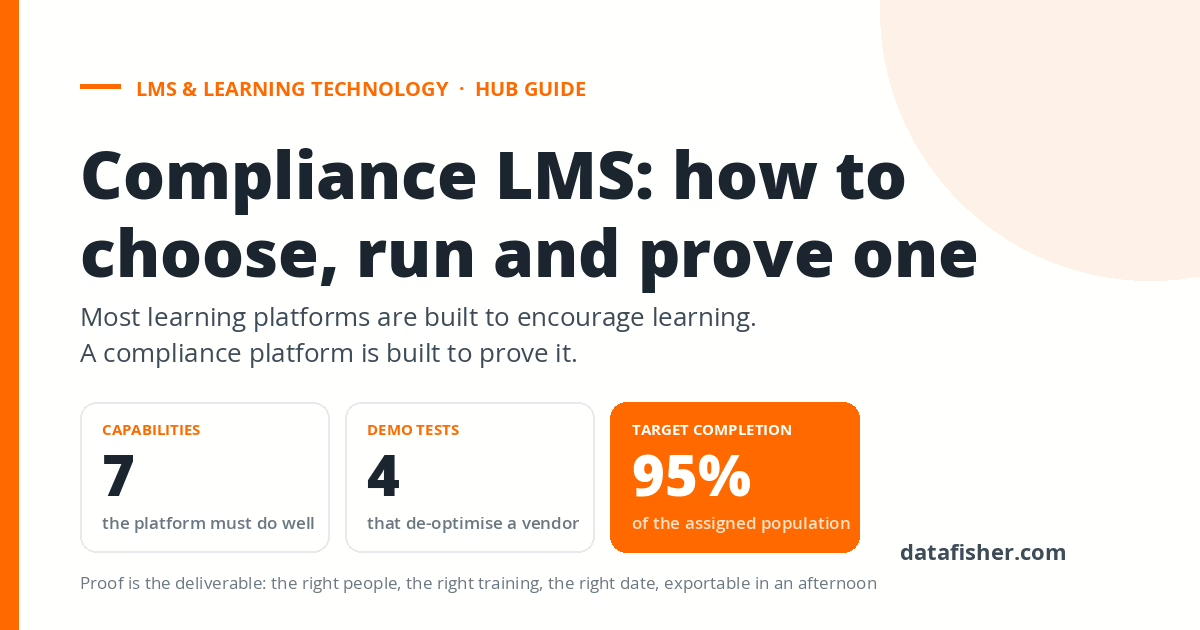
Compliance LMS: how to choose, run and prove one
Most learning platforms are built to encourage learning. A compliance platform is built to prove it. That single difference decides almost everything else about the product: how it handles enrolment, what it does when someone leaves the company, whether a completion record survives a licence change, and whether you can hand a supervisor an export without spending a week rebuilding it in a spreadsheet.
If you are buying for a compliance programme rather than for professional development, most of the market is answering a question you did not ask. This page is the map of the pillar: what a compliance LMS actually has to do, how to evaluate one when your obligations differ by country, and where the specific decisions are covered in more depth.
What makes a compliance LMS different
Four things separate the compliance use case from ordinary corporate learning, and each of them shows up as a feature you will not find on a generic engagement-first platform.
The audience is assigned, not attracted. In development learning, a course competes for attention and the platform’s job is to make it appealing. In compliance, the population is determined by risk, role and jurisdiction, the course is mandatory, and the platform’s job is to get an assigned population to a completed state without a human chasing each person. That means automated enrolment rules, deadline logic, escalation to line managers, and recurrence, not a recommendation engine.
The record outlives the learner. A development record is interesting while someone works for you. A compliance record has to be producible after they leave, sometimes years later, because the question a supervisor or an investigator asks is whether that specific person had that specific training on that specific date. That is a records management requirement wearing a learning platform’s clothes, and it collides with data minimisation in ways covered in article 55.
Content changes when the law changes. A leadership course written in 2021 is still broadly usable. An anti-money laundering course written in 2021 may now be wrong. A compliance platform needs versioning that distinguishes cosmetic edits from substantive ones, because if the content materially changed, the completions against the old version may no longer answer the question you need them to answer.
Proof is the deliverable. Everything else is instrumental. The output of a compliance training programme is not a trained workforce, satisfying as that is. It is a defensible statement that the right people were trained on the right things at the right time, and evidence to support it. If a platform cannot produce that evidence quickly, in the shape the supervisor asks for, it has failed at the only job that matters on the day it matters.
The Nordic complication
Everything above is true anywhere. What makes the Nordic buying decision genuinely different is that the same organisation is usually running one programme against several sets of national obligations at once.
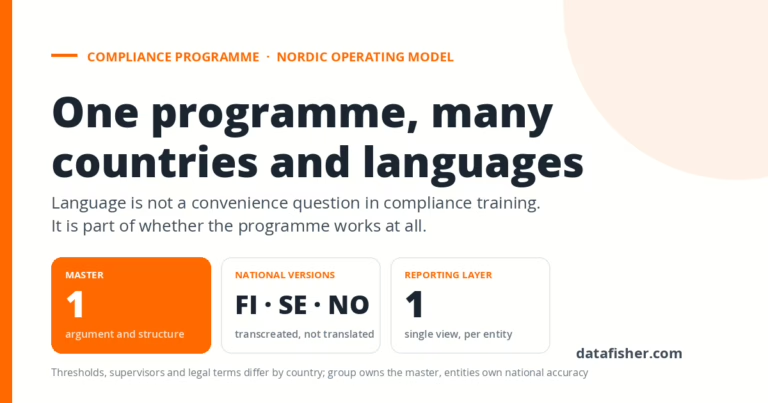
A group with entities in Finland, Sweden, Norway and Denmark is not running one compliance programme in four languages. It is running four overlapping obligation sets with a shared core. The whistleblowing threshold differs. The NIS2 training duty is scoped differently in Finnish and Swedish law. Working environment obligations on harassment sit in different instruments with different wording. A platform that models this as a language dropdown on a single global course will produce records that look tidy and answer the wrong question.
There are three practical consequences for platform selection.
You need a country dimension in the assignment logic, not only a role dimension. Article 47 covers how to build that matrix. Without it, you end up maintaining parallel course catalogues per entity, which is where most multi-country programmes quietly break.
You need language versions that can move at different speeds. The Finnish version of a course may need updating because Finnish law changed, while the Swedish version is still current. If versions are locked together, either you republish everything for a change that affects one country, or you delay a change that one country needs. Article 58 deals with this.
You need the rollout itself to survive local consultation duties. In Finland and Sweden, introducing a system that monitors employee activity is not purely an IT decision. Employee representatives are involved before it happens, not after, and the implementation timeline has to account for that. Article 60 covers the sequencing.
The capability checklist
When you strip out the marketing, a compliance LMS has to do seven things well. This is the short form of the evaluation scorecard, and article 52 turns it into a requirement list you can put into an RFP.
Assignment and enrolment. Rules based on attributes that come from your HR system, not manual lists. If someone changes role, country or entity, their curriculum should change without anyone remembering to change it. Test this in the demo with a real transfer scenario, not a new hire.
Deadlines, reminders and escalation. Configurable per course, per population. Reminders that go to the learner, then to the manager, on a cadence you set rather than one the vendor set. Article 59 covers what cadence actually works.
Recurrence. Annual is the default assumption and it is usually wrong. Some training is genuinely annual, much of it is triggered by role change or incident, and some has no legal frequency at all. The platform should support all three patterns rather than forcing everything into a yearly cycle.
Multi-language delivery. Not just a translated interface. Separate content versions per language, independently versioned, with a defined fallback when a language version does not exist.
Reporting and evidence export. Completion by person, by course version, by date, by entity, filterable and exportable without vendor involvement. Ask to see the export in the demo. A dashboard that looks impressive on screen but cannot produce a per-person evidence file is a liability.
Content standards support. Whether the platform reads SCORM, xAPI or cmi5 decides how portable your course library is and what data you get back about learner behaviour. Article 53 explains which standard matters for which purpose.
Data lifecycle controls. Retention rules, deletion routines, and a clear answer on what happens to a leaver’s record. Article 55 covers what you can keep and on what basis.
Buy the content, the platform, or both
The market splits into three kinds of vendor and the distinction matters more than the feature comparison.
Platform-only vendors sell you the delivery system and expect you to supply courses, either by licensing them separately or building them in an authoring tool. Content-only vendors sell courses that run inside whatever platform you already have. Combined vendors sell both.
Platform-only is the right answer when you already own substantial content and your main problem is delivery and evidence. Content-only is right when your platform is fine and your courses are stale. Combined is right when the content is the actual problem, which for compliance it usually is, because writing an accurate anti-bribery course for four jurisdictions is harder and more expensive than most organisations expect when they start.
The trap in the combined model is lock-in, and the specific thing to test is whether you can take your completion history and your content out. Ask for an export sample during evaluation, not during the exit negotiation. Article 62 covers the commercial terms that make this easy or hard.
What to test in a demo
Vendor demos are optimised. You can de-optimise them with four requests, and how a vendor handles them tells you more than the feature list does.
- Ask them to enrol a fictional employee in a Finnish entity, then move that employee to the Swedish entity, and show what happens to the curriculum without anyone touching it manually.
- Ask them to produce a completion certificate for a named person on a named course version, then ask what that record looks like eighteen months after that person leaves.
- Ask them to show the same course in two languages and change one language version without republishing the other.
- Ask them to export the evidence pack for one entity for one year, in the demo, and look at what comes out.
If any of those four takes a follow-up call to answer, that is your answer. These are not exotic requirements. They are the ordinary operating conditions of a multi-country compliance programme, and a platform built for that use case handles them without ceremony.
Where these programmes go wrong
Five failure patterns account for most of the trouble, and none of them is a platform defect.
The assignment model is decided after the platform. The matrix of who needs what, by role and country, is a compliance decision. If it is still being argued about when configuration starts, the configuration encodes the argument. Article 47 covers building it first.
HR data is assumed to be good. It rarely is. Free text job titles, missing country fields, people with no manager set, contractors invisible to the feed. Every one of those becomes an enrolment defect that looks like non-compliance. Article 54 covers the data work that has to happen before integration.
Localisation starts after the platform is live. Content in one language goes live, the other language versions are commissioned afterwards, and for six months half the organisation receives a course in a language they do not work in. Article 58 covers why that is an architecture decision rather than a translation invoice.
Nobody owns it after the project ends. The implementation project has a manager, a steering group and a budget. Steady-state operation frequently has none of the three, and a programme with no owner degrades quietly: assignment rules stop matching the organisation, courses pass their review date, reports nobody runs stop working.
The evidence requirement is tested for the first time during an audit. Every one of the four questions in the section above is easy to answer in advance and unpleasant to answer under time pressure. Run the evidence export once a quarter whether or not anyone has asked for it.
What good looks like in steady state
A programme that is working has a recognisable shape. Assignment is automatic and reflects the organisation as it is today, not as it was at go-live. Completion sits above 95 percent for the assigned population, with the remainder explainable as people inside their window or on leave. Course reviews happen on a schedule and overdue reviews are visible. Retention runs automatically rather than as an annual clean-up. And the evidence pack for any entity and any year can be produced by one person in an afternoon.
None of that requires an unusual platform. It requires the assignment model, the data, the language plan and the ownership to have been decided deliberately, which is what the rest of this pillar is about.
The questions this pillar answers
| Question | Where it is covered |
|---|---|
| What do I put in the requirement list or RFP? | LMS requirements checklist for compliance training |
| Which content standard do I actually need? | SCORM, xAPI and cmi5 explained |
| How does the platform connect to our HR system? | LMS and HR system integration |
| What learner data can we keep, and for how long? | GDPR and your LMS |
| What are the accessibility obligations? | Accessible e-learning: WCAG 2.2 and the EAA |
| Is an LXP a better fit than an LMS? | LMS, LXP or training platform |
| How do we run one platform in five languages? | Running one LMS across the Nordics |
| How do we get completion rates up? | Getting completion above 95 percent |
| What does implementation look like? | LMS implementation in 90 days |
| Should we build courses or license them? | Off the shelf or your own authoring tool |
| What will it cost? | What an LMS really costs |
Frequently asked questions
What is a compliance LMS?
A compliance LMS is a learning management system configured for mandatory training: automated assignment by role, country and risk, deadline and reminder logic, versioned course content, retained completion records, and audit-ready reporting. The distinguishing feature is not the courses it delivers but the evidence it produces.
Can we use our existing HR system’s learning module instead?
Sometimes. HR suites increasingly include a learning module, and if your compliance training is simple, single-country and low-risk, that may be enough. The usual limits are multi-language content versioning, granular course versioning, and evidence export in a form a supervisor accepts. Test those three specifically before deciding the bundled module is sufficient.
Do we need a separate platform for each country?
No, and doing so is usually a mistake. What you need is one platform that models country as a dimension of assignment and content, so that Finnish and Swedish learners get different course versions and different curricula from the same system. Separate platforms per entity multiply administration and make group-level reporting nearly impossible.
How long do we have to keep training records?
Long enough to demonstrate compliance for the period a supervisor or court might ask about, which is not a single number and depends on the obligation and the country. That has to be reconciled with the GDPR storage limitation principle, which means a documented retention schedule rather than keeping everything indefinitely. Article 55 and article 49 cover this in detail.
What is the difference between an LMS and an LXP?
An LMS manages assigned training and produces records. An LXP curates content and encourages discovery. For compliance obligations, the LMS model is what produces evidence. Many organisations run both, for different purposes.
How long does implementation take?
For a mid-sized Nordic organisation with reasonably clean HR data, a first mandatory course can be live to a pilot population in around 30 days and to the full organisation within 90. The variables that stretch it are HR data quality, integration scope, content readiness and local consultation requirements, not the platform itself.
Sources and further reading
- Regulation (EU) 2016/679 (GDPR) – EUR-Lex; Article 5(1)(e) sets the storage limitation principle relevant to training records
- Directive (EU) 2022/2555 (NIS 2 Directive) – EUR-Lex; Article 20 contains the management-body training duty referred to above
- Directive (EU) 2019/882 (European Accessibility Act) – EUR-Lex
- Web accessibility laws and policies: European Union – W3C Web Accessibility Initiative, mapping EU instruments to WCAG
- cmi5 specification: SCORM vs cmi5 comparison – AICC / ADL
- xAPI SCORM Profile – ADL Initiative, on GitHub
- cmi5 and the xAPI SCORM Profile – ADL Initiative news
Related articles
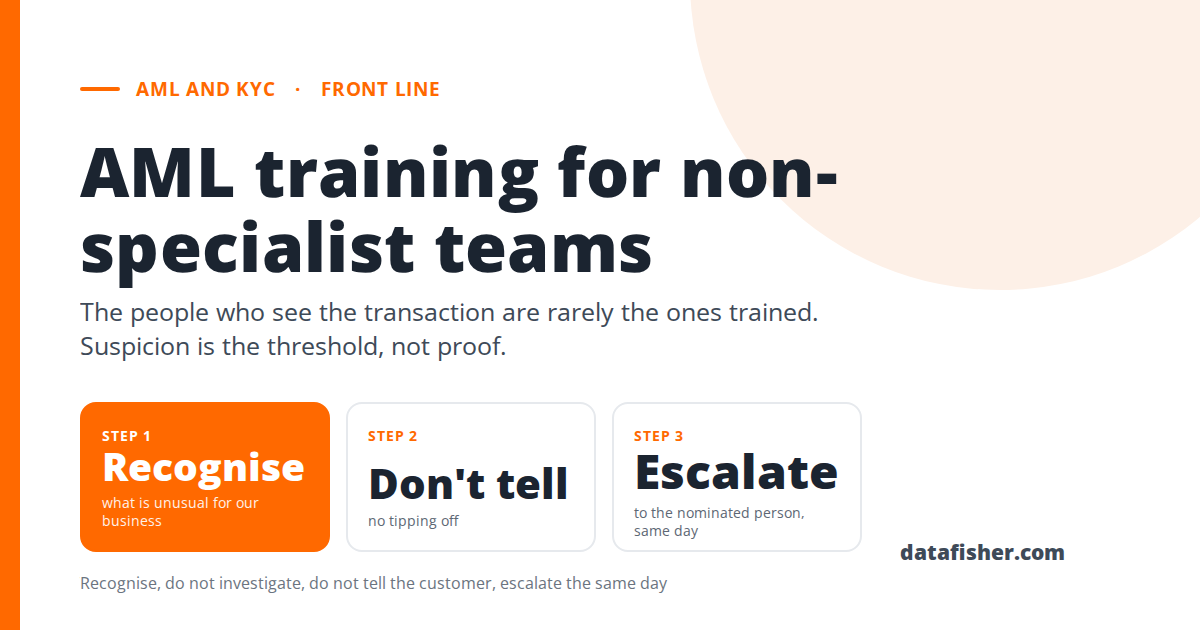 AML Training for Non-Specialist Teams: What the Front Line Needs to Know
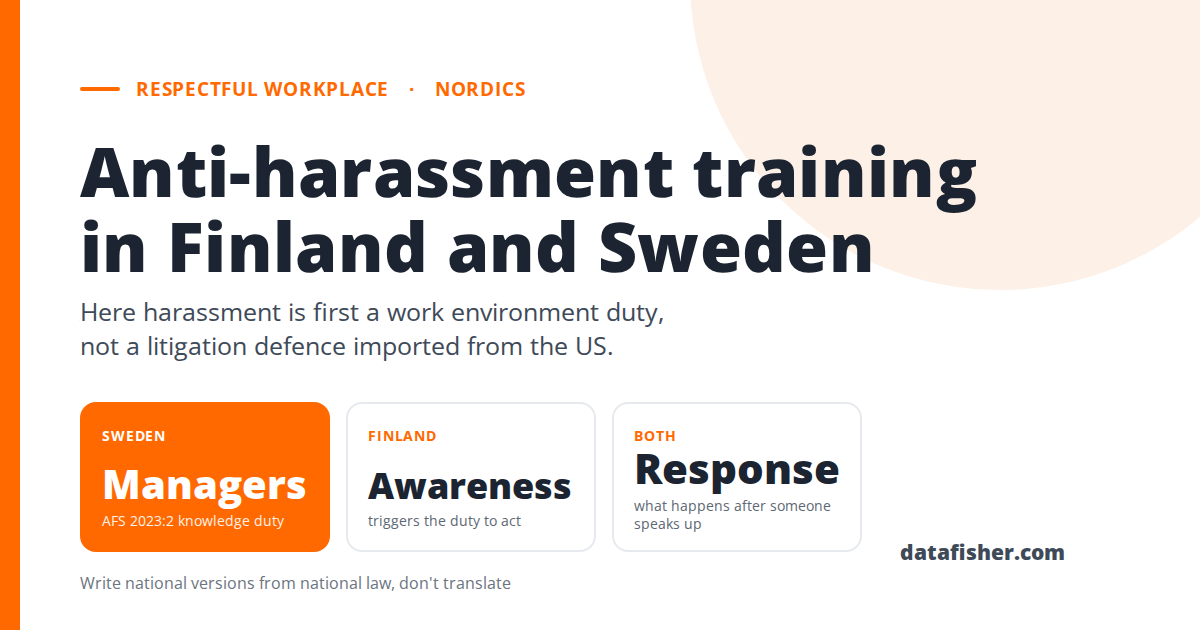 Anti-Harassment Training in the Nordics: What Finnish and Swedish Law Actually Requires
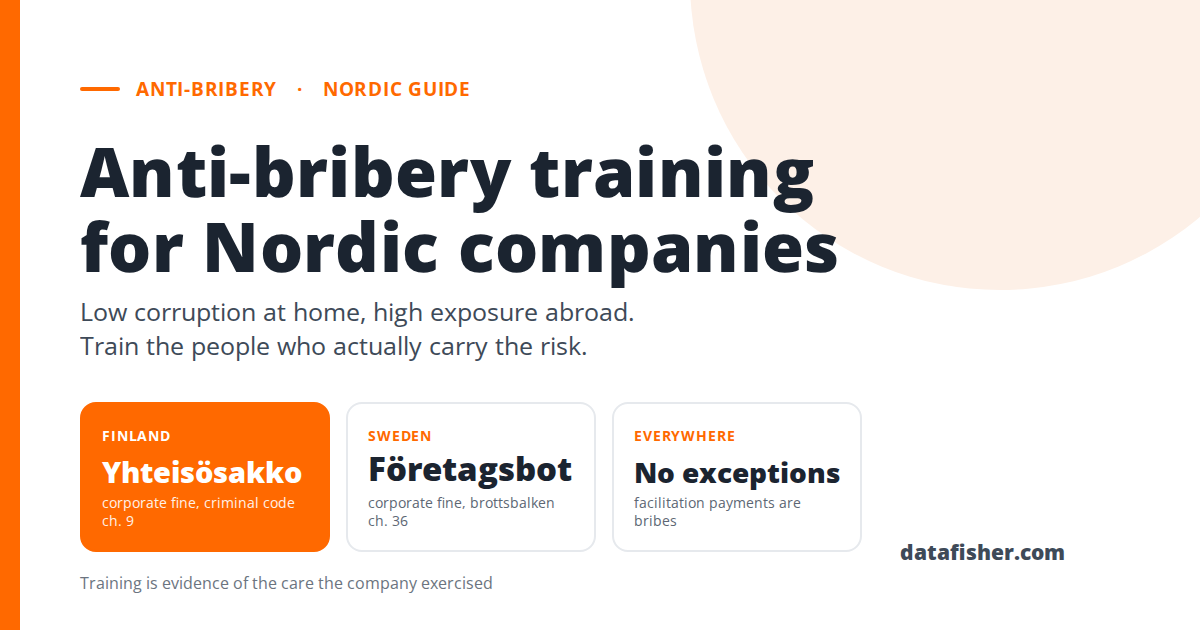 Anti-Bribery Training: A Practical Nordic Guide to Anti-Corruption
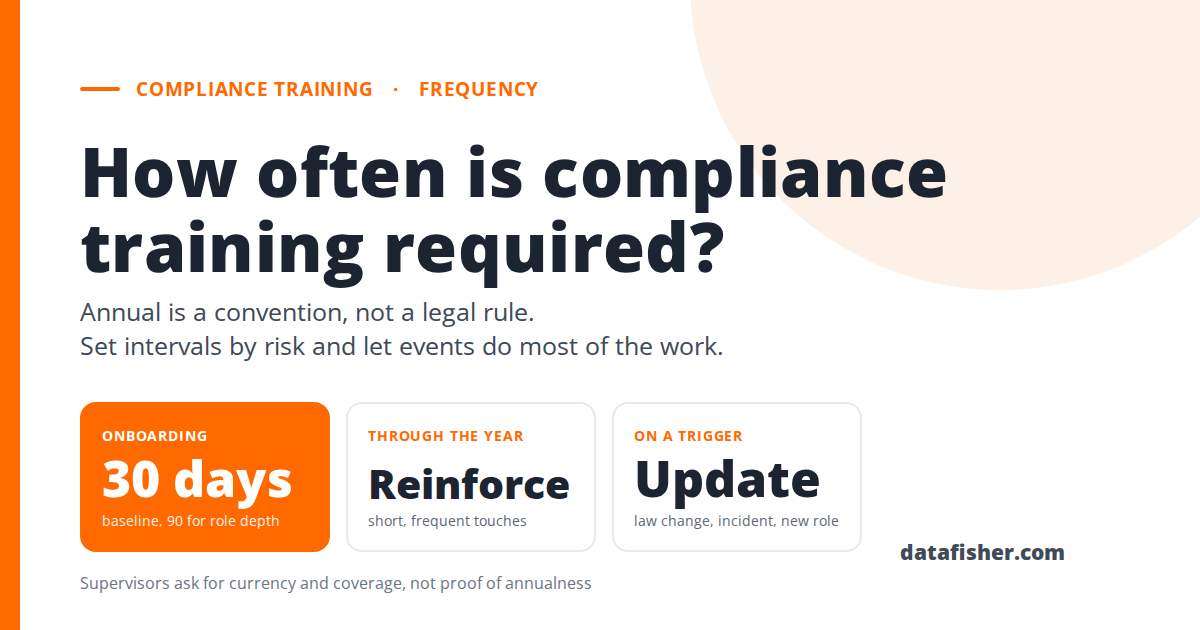 How Often Is Compliance Training Required? Setting a Defensible Frequency
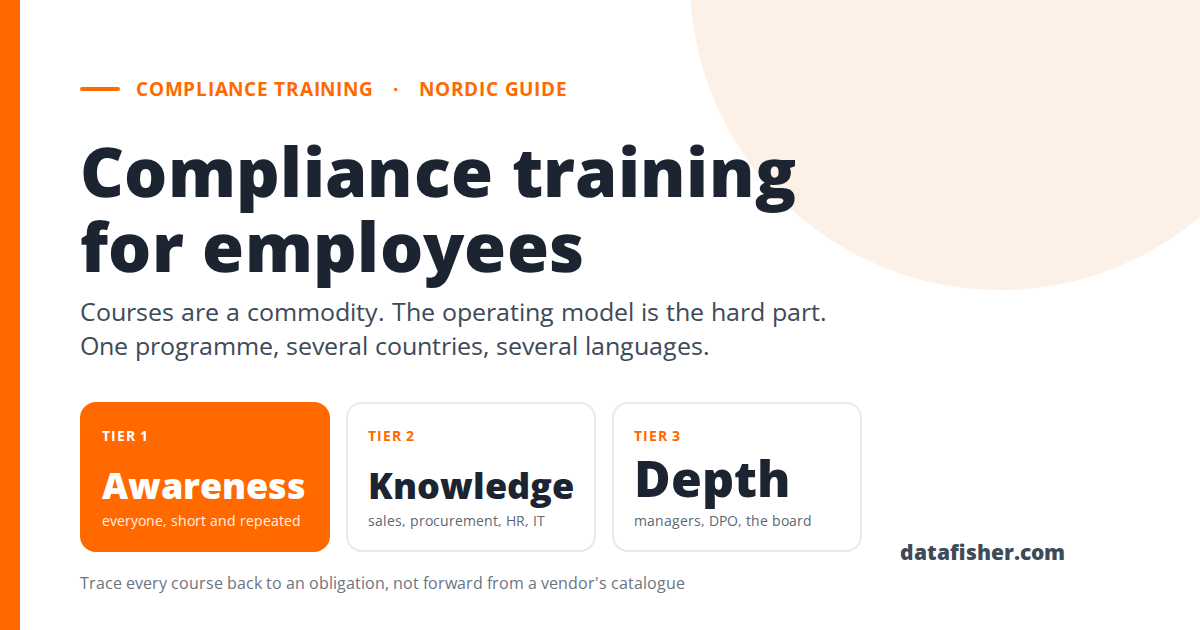 Compliance Training for Employees: A Complete Nordic Guide
 ESG and Sustainability Compliance Training After the Omnibus
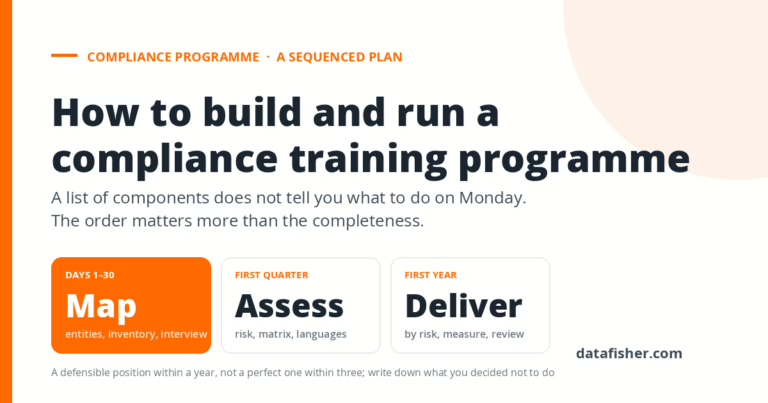 How to Build and Run a Compliance Training Programme
 One Compliance Programme, Many Countries and Languages: A Nordic Operating Model
 AI Literacy Training Under the EU AI Act: What Article 4 Requires in 2026