
Compliance Training for Employees: A Complete Nordic Guide
The hard part of compliance training in a Nordic company is almost never the content. Courses on bribery, data protection and security awareness are commodities, available from a dozen vendors and largely interchangeable in substance.
The hard part is the operating model. Which entity owns the programme. Which language each employee is entitled to receive it in. How employee representatives are involved before it launches. How completion is documented across countries with different supervisors asking for different evidence. Whether the group parent’s catalogue actually reflects Finnish or Swedish law.
A compliance training programme in a Nordic group is a coordination problem before it is a content problem, and organisations that treat it as a purchasing decision discover this in month four. This guide covers what the training is legally for, what it must cover, who needs which level, and how to run one programme across several countries and languages.
What compliance training is legally for
There is no single act titled compliance training. The obligation behind regulatory compliance training is assembled from many sources, and understanding which source drives which course is what allows you to defend the programme later.
Some duties are explicit:
Cyber security. Both Finland’s Cybersecurity Act (124/2025) and Sweden’s Cybersäkerhetslag (2025:1506) require training of the management body.
Workplace conduct. Sweden’s work environment regulations (AFS 2023:2) require that managers and supervisors have knowledge of how to prevent and handle unhealthy workload and kränkande särbehandling (victimisation).
Anti-money laundering. National money laundering legislation, such as Finland’s Act on Preventing Money Laundering and Terrorist Financing (444/2017) and Sweden’s penningtvättslagen (2017:630), requires obliged entities to train employees appropriately for their duties.
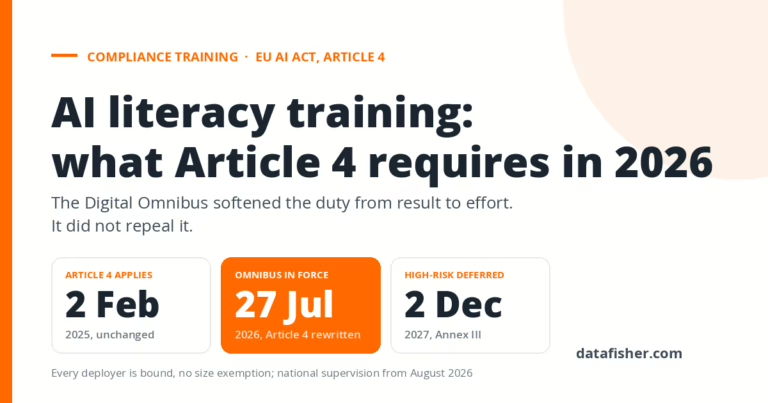
AI literacy. The EU AI Act requires providers and deployers to take measures supporting AI literacy among staff.
Most duties are implicit. Data protection law under the GDPR requires appropriate organisational measures, and training is one. Corporate criminal liability in Finland and Sweden turns on whether the company exercised the care required to prevent an offence, and training is central evidence of that care. Occupational safety law requires employers to act on harassment once aware, which requires managers who can recognise it.
Your compliance training catalogue should be traceable backwards to obligations, not forwards from a vendor’s course list. If you cannot say which duty a course discharges, you cannot explain to a supervisor why you deliver it, or defend not delivering something else.
What compliance training must cover in the Nordics
Working from that mapping, a common Nordic core emerges for most mid-sized organisations:
Data protection. GDPR compliance training for everyone who handles personal data, which is nearly everyone.
Information and cyber security. Security awareness for all staff, with the management body treated as a separate and legally distinct audience.
Workplace conduct. With managers as the priority population.
Whistleblowing. Delivered at three levels of depth, matching the tiers below.
Anti-bribery and conflicts of interest. Weighted heavily toward export-facing roles.
Competition law. For commercial and tendering teams.
AI use. Now that Article 4 of the AI Act applies to deployers.
Sector adds to this. Financial services, healthcare, construction, food and defence each bring their own supervised requirements.
What should not be in the list is anything you cannot connect to a risk in your organisation. Programmes bloat because adding a module feels safer than omitting one, and the result is a workforce that treats all of it as noise.
Who needs what: by exposure, not by headcount
Assign training by what people actually do rather than by job title. Nordic organisations are flat, job scopes are broad, and titles carry less information about exposure here than in more hierarchical structures. A single person in a forty-person subsidiary routinely holds three exposed activities at once.
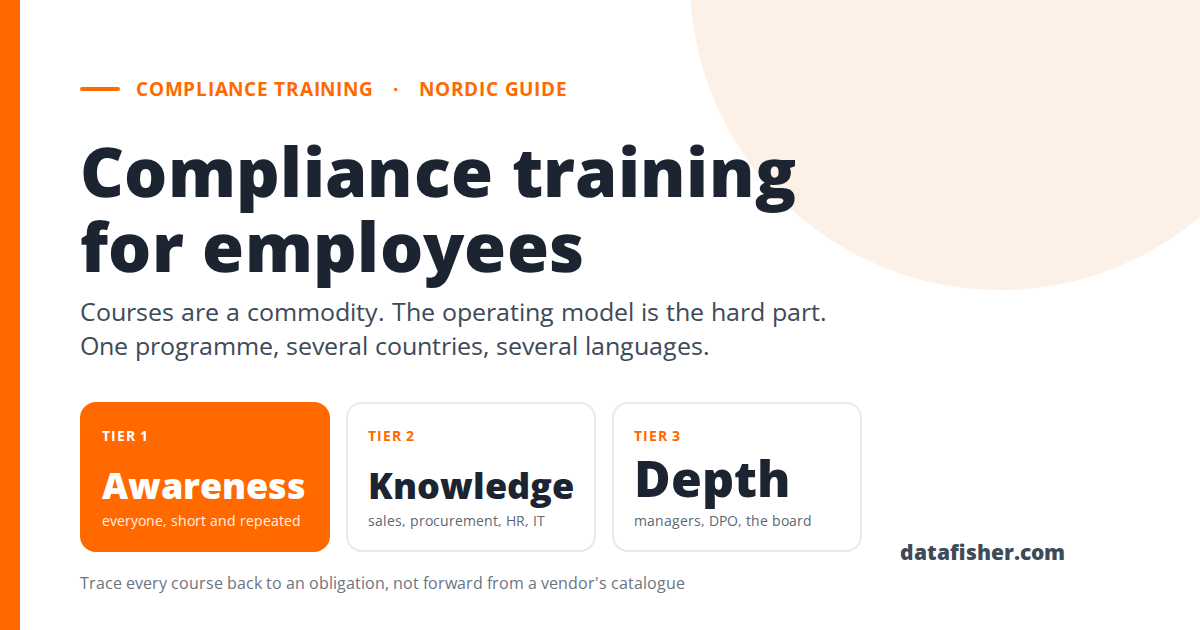
Three tiers work for most organisations:
Awareness for everyone. Enough to recognise a situation and know where to take it. Short, repeated, and focused on escalation rather than on rules.
Working knowledge for recurring exposure. Sales, procurement, HR, finance, IT, and anyone dealing with third parties or public officials.
Depth for decision-makers and case handlers. Managers, case handlers, the nominated AML person, the DPO, and the management body.
Record the reasoning, including where you decided a group needed less. Risk-based programmes are defensible only when the negative decisions are written down.
The language question is a legal question
This is where Nordic programmes most often carry hidden risk, and where the group parent’s assumptions cause most damage.
English proficiency across Finland, Sweden, Norway and Denmark is exceptional, and it tempts groups into English-only delivery. The gap that matters is not conversational fluency. It is whether an employee will accurately recognise a situation, months later, under time pressure, in a second language.
That has a documentary consequence. If a manager is later dismissed for breaching a policy, or the company argues it exercised due care before an incident, the strength of that argument depends on showing the person understood what was required. Training delivered in a language they have never worked in is a weaker foundation than training in the language they think in.
Finland adds a domestic dimension that international groups routinely miss. Finland has two national languages, and a Finnish employer with Swedish-speaking employees is not making an export decision when it considers Swedish. It is addressing its own workforce.
Decide languages by workforce composition and role exposure rather than by country list. Production supervisors, warehouse leads and field service staff are frequently the least served by English-only programmes and among the most exposed.
Employee consultation will affect your timeline
Rolling out mandatory compliance training that creates new obligations for employees is not purely a management decision in either country.
Finnish employers operate under the Act on Co-operation within Undertakings (1333/2021), which requires dialogue with personnel on matters affecting the position of employees. Swedish employers operate under the Co-Determination Act (MBL), with primary negotiation duties before significant changes. Introducing monitoring of completion, or attaching consequences to non-completion, sits squarely in that territory. In Finland, the Act on the Protection of Privacy in Working Life (759/2004) adds further constraints on how employees may be monitored.
Groups that treat this as a formality at the end of the project lose weeks. Bringing employee representatives in during design costs almost nothing, usually improves the programme, and removes the most common cause of launch delay.
Build an annual cycle, not an annual event
The dominant model is an annual campaign: assign everything in October, chase completions through November, report 97 percent in December, do nothing until the following October.
It produces good statistics and poor retention. Recognition decays, the regulatory picture moves, and new joiners spend up to eleven months untrained.
A better rhythm has four parts:
Onboarding. Substantive modules within a defined window after joining.
Reinforcement. Short refreshers distributed through the year.
Event-triggered content. Released when something material changes.
Annual review. One documented review of whether the programme still matches the risk.
2026 alone has produced material change in AI, cyber and sustainability obligations, and a programme reviewed only in December would have been carrying stale content for most of the year.
Measuring compliance training beyond completion
Completion is an attendance record. It tells you the module was opened, not that anything changed.
Add comprehension where assessment is meaningful, and behavioural proxies, which are more informative than either: reports raised through the whistleblowing channel, pre-approval requests for gifts and hospitality, questions arriving at the compliance inbox, consultation of policies.
Rising numbers on those generally indicate the programme is working, and boards frequently read them backwards. Frame that before the numbers are presented rather than afterwards.
Documenting compliance training across countries
Different supervisors ask for different evidence, and a single completion export satisfies none of them well.
Data protection authority. Evidence that training occurred and covered the right people.
Cyber supervisor. Evidence of management body training specifically, documented by name.
AML supervisor. Evidence of role-appropriate, recurring training, with content retained.
Work environment authority. Evidence that managers have the required knowledge.
Keep the risk mapping, dated content versions, delivery records including new joiners and relevant contractors, and the review cycle.
Assemble the audit pack continuously rather than reconstructing it on demand. A programme that can show its obligation mapping, its content versions and who received what, when, is a programme you can defend.
Choosing between group system, standalone platform and LMS
If the group already runs a global system, the practical question is not whether to use it but whether it can hold country-specific variants of the same course and report on them separately. Many cannot, and that limitation quietly forces either legally inaccurate content or unreportable local workarounds.
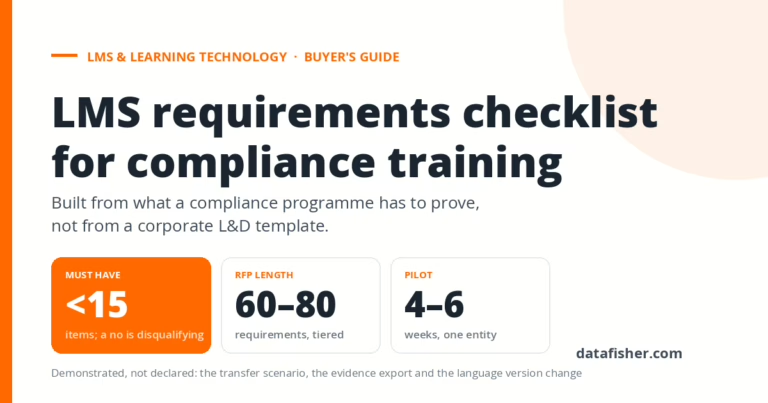
If you are buying online compliance training or an LMS for compliance training, the questions that matter are:
Language versions. Does the platform support multiple language variants of one course as versions rather than as unrelated items?
Entity reporting. Can it report across legal entities in one view?
Data portability. Can you export your own data in a usable form?
Version history. Can content be updated without losing the record of what previous cohorts actually received?
Frequently asked questions
What is compliance training?
Compliance training is the training an employer gives employees so they can recognise and act on the legal obligations and internal policies that apply to their work. In the Nordics it typically covers data protection, security, workplace conduct, whistleblowing, anti-bribery, competition law and AI use.
Is compliance training mandatory in Finland and Sweden?
There is no single act requiring it. Explicit duties exist for management body cyber training, AML training for obliged entities, manager knowledge on workplace conduct in Sweden, and AI literacy under the AI Act. Elsewhere the requirement is implicit in obligations to take appropriate organisational measures and to exercise care.
What topics should compliance training cover?
Work backwards from the obligations that apply to your organisation rather than forwards from a catalogue of compliance training courses. A typical Nordic core covers data protection, information security, workplace conduct, whistleblowing, anti-bribery, competition law and AI use, plus sector requirements.
Who is responsible for compliance training?
The employer. Delivery can be delegated to a provider and to the line organisation, but accountability cannot be transferred, and someone should be named as owner with a board-level sponsor.
Does compliance training have to be in the employee’s own language?
There is rarely an express statutory right. The exposure runs the other way: where an employee could not reasonably have understood the training, the employer’s ability to show it discharged the underlying duty is weakened. Finland’s two national languages make this a domestic question for many employers.
How often should compliance training be repeated?
Very few obligations fix an interval. Onboarding, reinforcement through the year, event-triggered updates and a documented annual review is a defensible pattern.
Can employees refuse mandatory compliance training?
Attaching consequences to non-completion engages consultation obligations in both Finland and Sweden and should be handled through the agreed process rather than improvised. Persistent refusal is usually a symptom of poor communication about why the training exists.
How much does compliance training cost?
Licences are the visible cost and rarely the largest. Proper localisation and internal time typically exceed it, and internal time is the component most often missing from the business case.
Can one compliance training course serve our whole Nordic group?
One programme, yes. One identical course, no. Cyber training duties, workplace conduct concepts and whistleblowing thresholds all differ between the Nordic countries, so national versions need to differ in substance rather than only in language.
Sources and further reading
- Cybersecurity Act 124/2025 – Finlex, Finland; management body training duty
- Cybersäkerhetslag (2025:1506) – Sveriges riksdag; Swedish Cybersecurity Act
- AFS 2023:2 – Arbetsmiljöverket; manager knowledge on workload and victimisation
- Act on Preventing Money Laundering and Terrorist Financing 444/2017 – Finlex, Finland
- Lag (2017:630) om åtgärder mot penningtvätt och finansiering av terrorism – Sveriges riksdag
- Regulation (EU) 2016/679 (GDPR) – EUR-Lex; organisational measures for data protection
- Regulation (EU) 2024/1689 (AI Act) – EUR-Lex; Article 4 AI literacy
- Act on Co-operation within Undertakings 1333/2021 – Finlex, unofficial English translation
- Employment (Co-Determination in the Workplace) Act (1976:580) – Government Offices of Sweden
- Act on the Protection of Privacy in Working Life 759/2004 – Finlex, Finland (in Finnish)
Related articles
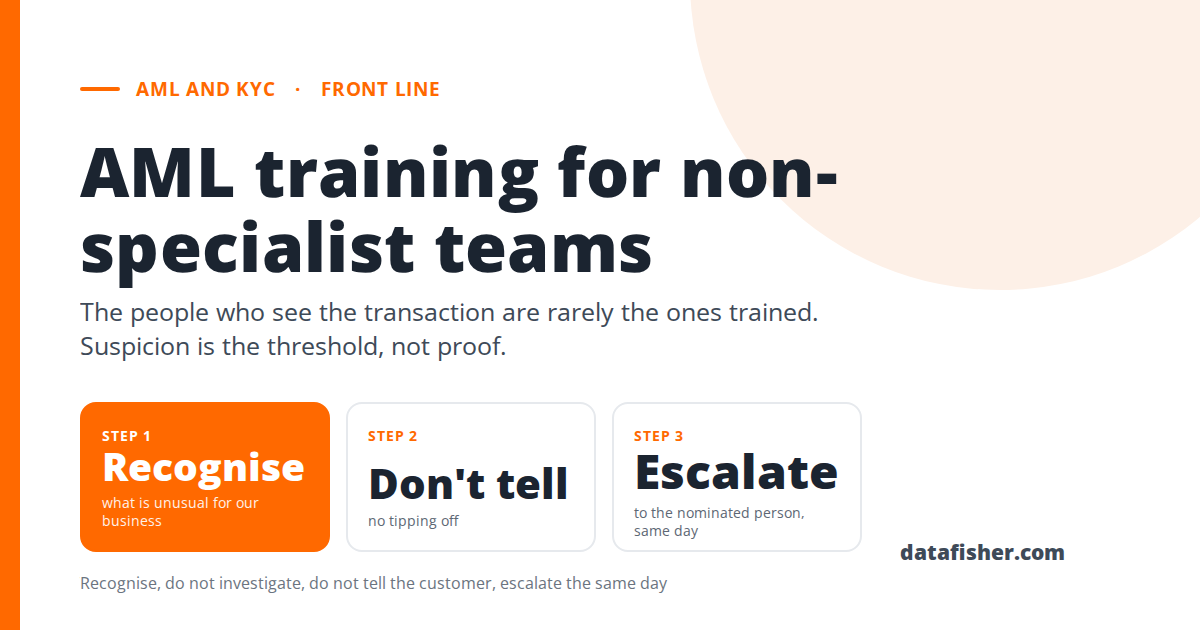 AML Training for Non-Specialist Teams: What the Front Line Needs to Know
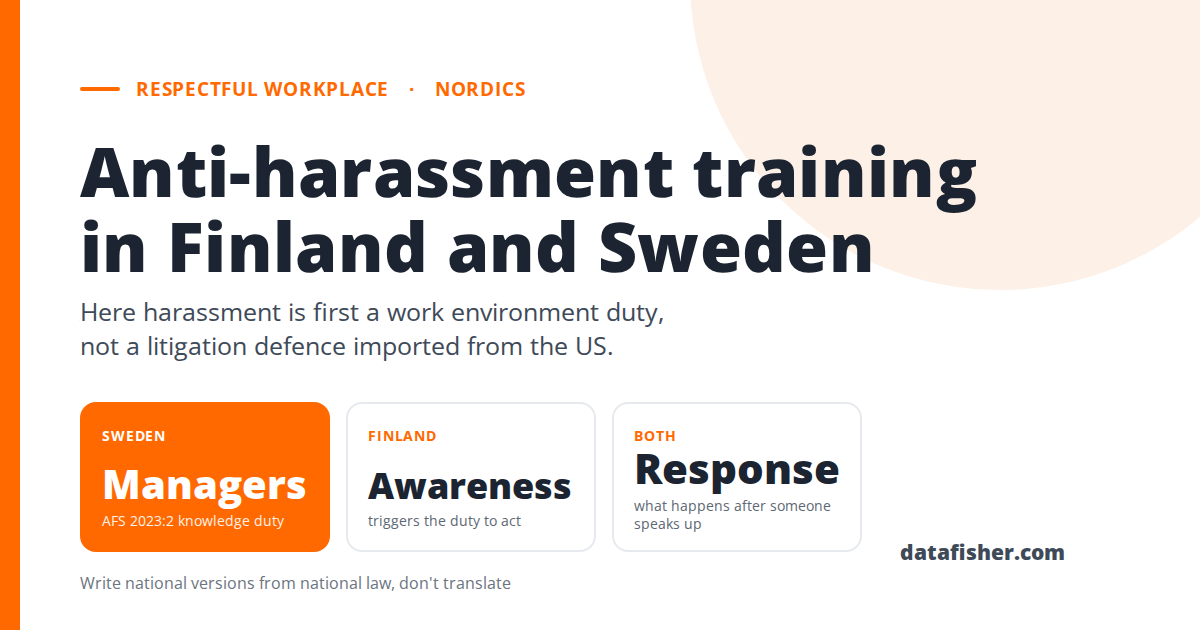 Anti-Harassment Training in the Nordics: What Finnish and Swedish Law Actually Requires
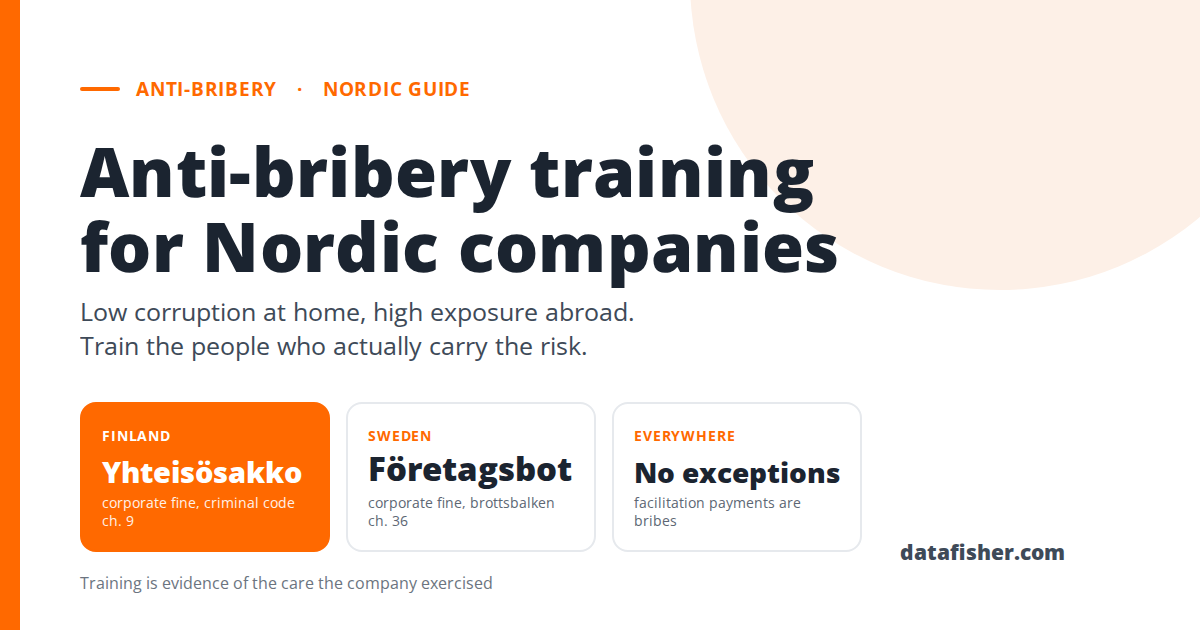 Anti-Bribery Training: A Practical Nordic Guide to Anti-Corruption
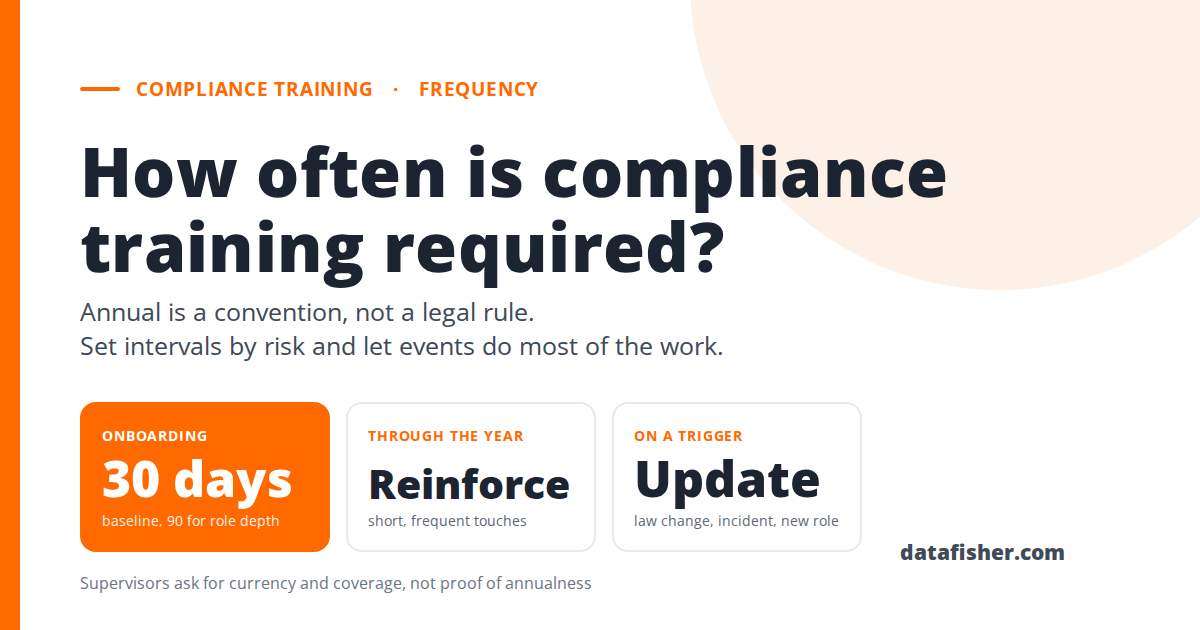 How Often Is Compliance Training Required? Setting a Defensible Frequency
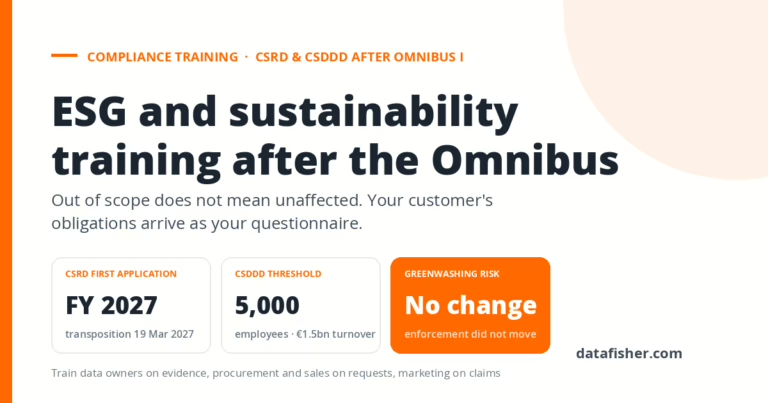 ESG and Sustainability Compliance Training After the Omnibus
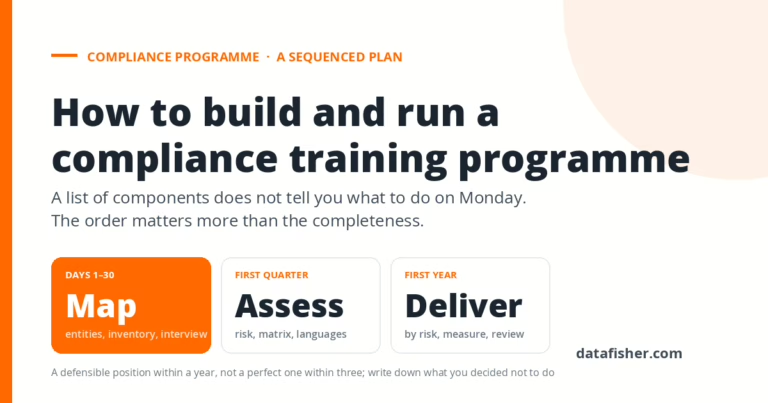 How to Build and Run a Compliance Training Programme
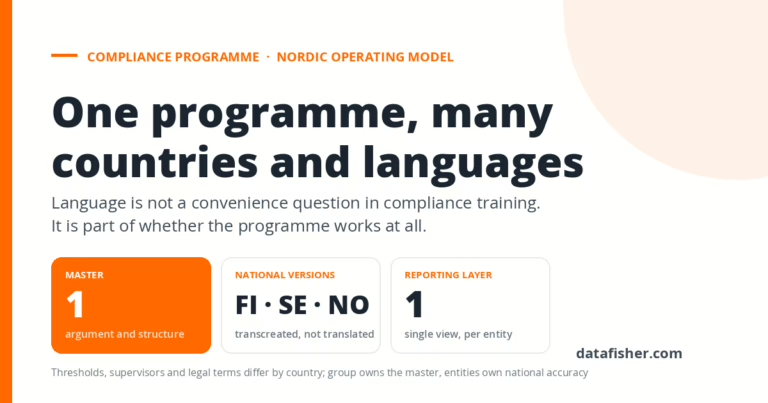 One Compliance Programme, Many Countries and Languages: A Nordic Operating Model
 AI Literacy Training Under the EU AI Act: What Article 4 Requires in 2026
 LMS requirements checklist for compliance training