
News.
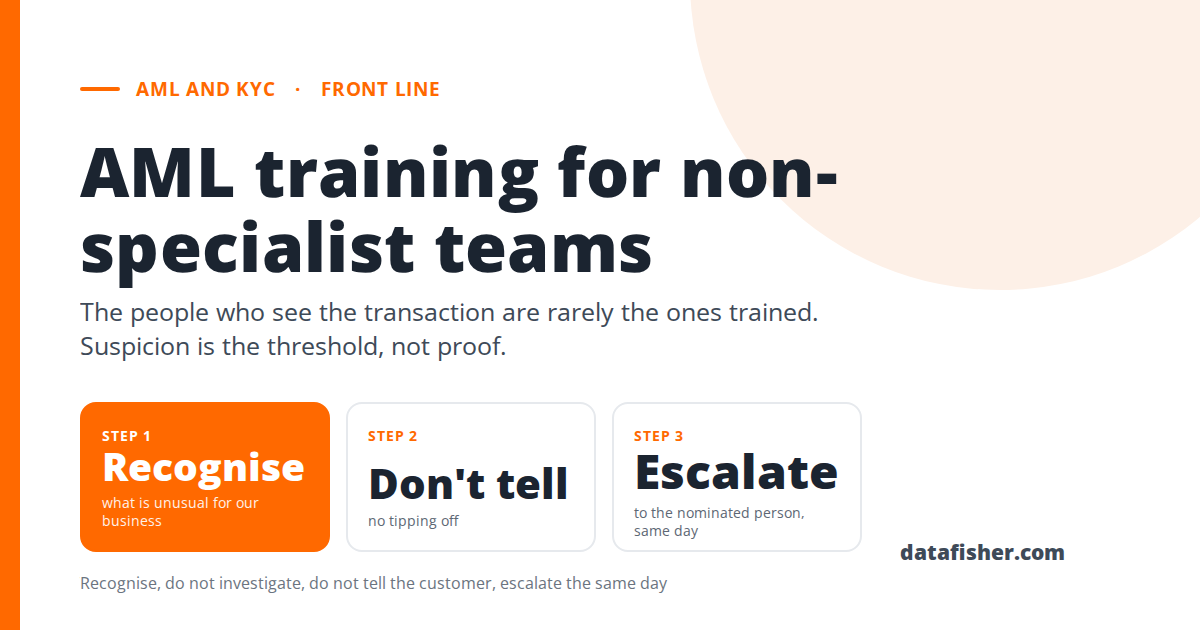
AML Training for Non-Specialist Teams: What the Front Line Needs to Know
AML Training for Non-Specialist Teams: What the Front Line Needs to Know AML training usually reaches the specialists and misses the people who actually meet the customer. The compliance officer knows the risk-based approach. The estate agent, the accountant, the car dealership sales manager and the corporate services administrator are the ones who see the transaction, and they frequently received a slide deck three years ago. That gap is where most anti-money laundering failures happen. This guide is about closing it: who counts as an obliged entity in Finland and Sweden, what AML and KYC...
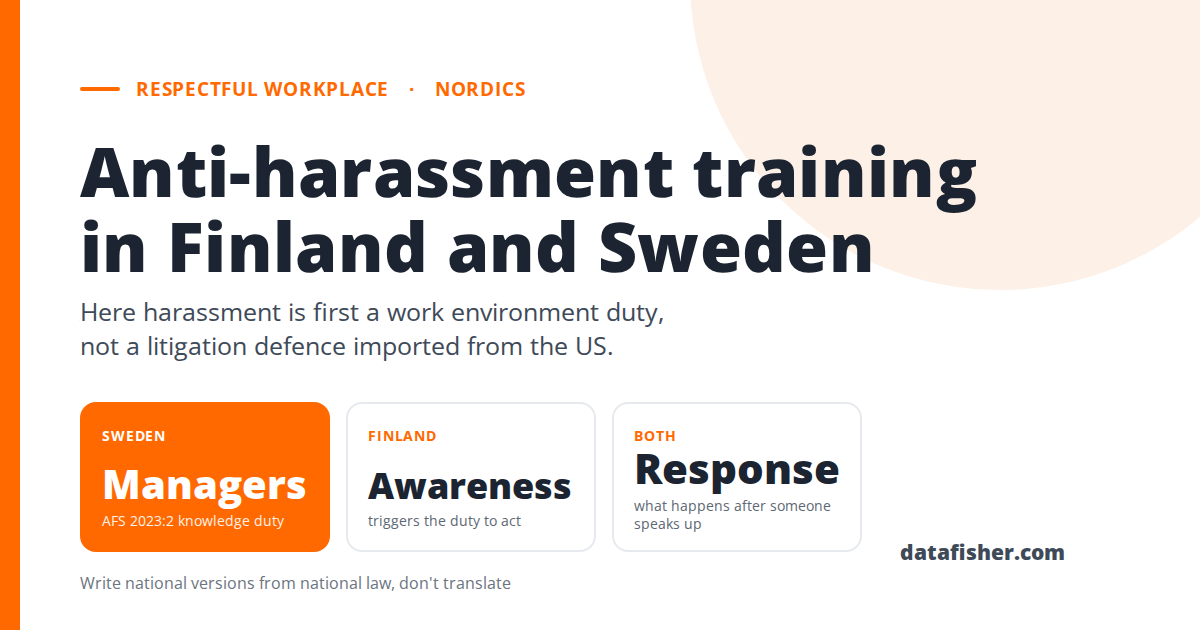
Anti-Harassment Training in the Nordics: What Finnish and Swedish Law Actually Requires
Anti-Harassment Training in the Nordics: What Finnish and Swedish Law Actually Requires If your anti-harassment training was written in the United States, it is built on a legal theory that does not apply to you. In Finland and Sweden, harassment is first a question of occupational health and safety, and that changes what the training must contain. American harassment training exists largely to establish an employer defence in discrimination litigation. It is organised around protected categories, around what constitutes a hostile work environment, and around demonstrating that the employer...
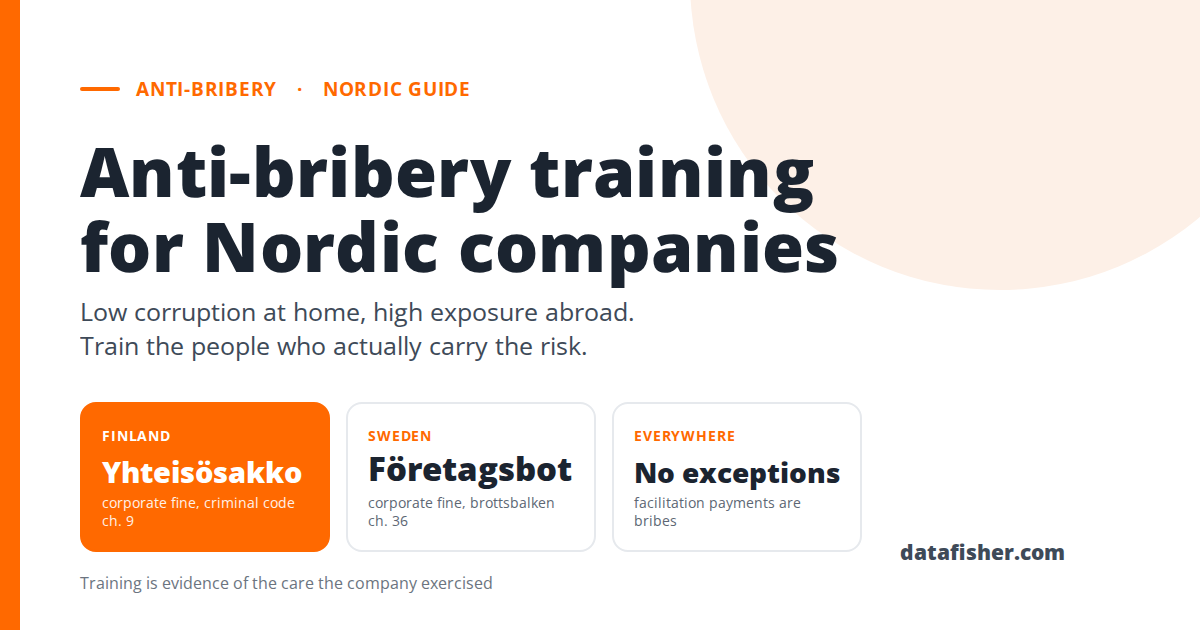
Anti-Bribery Training: A Practical Nordic Guide to Anti-Corruption
Anti-Bribery Training: A Practical Nordic Guide to Anti-Corruption Search for anti-bribery training in English and almost everything you find is built on the UK Bribery Act. It describes the legal position of a company in London. It does not describe the position of a company in Helsinki or Stockholm, and building your anti-corruption programme on it means building it on a defence you cannot plead. The typical guide explains the offences, then the adequate procedures defence, then explains that training is one of the six principles that make up adequate procedures. It is a coherent argument....
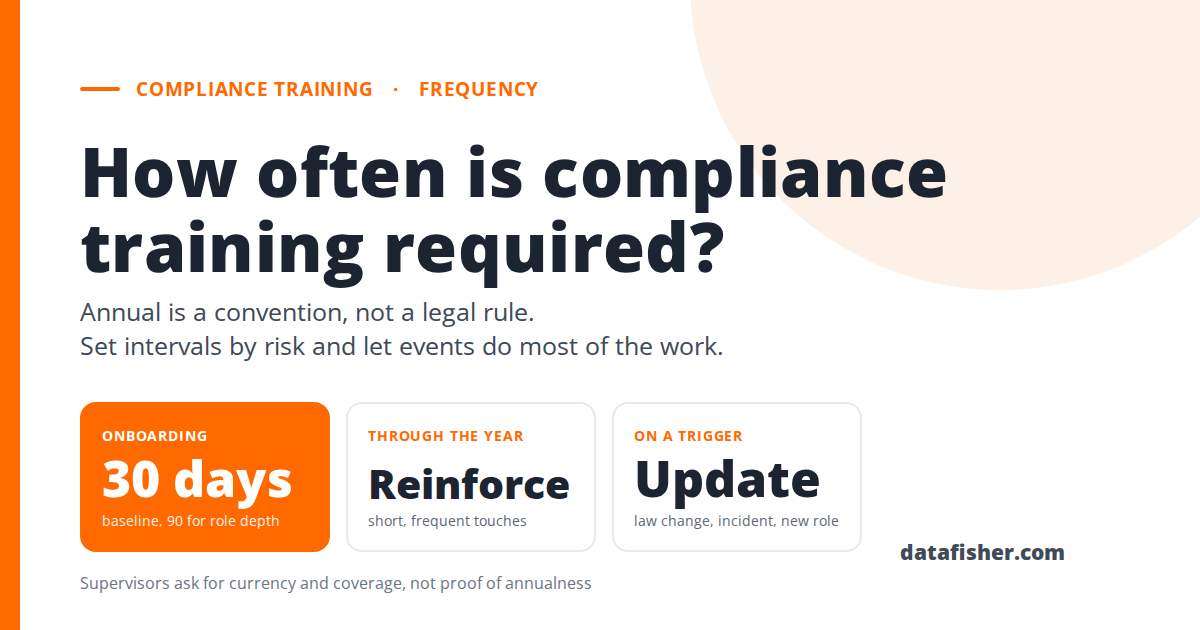
How Often Is Compliance Training Required? Setting a Defensible Frequency
How Often Is Compliance Training Required? Setting a Defensible Frequency How often is compliance training required? The honest answer is that in most areas no law tells you, and anyone who gives you a confident number is describing a convention rather than a requirement. That is worth saying plainly, because the internet is full of articles asserting that compliance training must be annual. It must not. Annual compliance training is what most organisations do, largely because HR systems and audit cycles run annually, and it has been repeated often enough to sound like a rule. What matters...
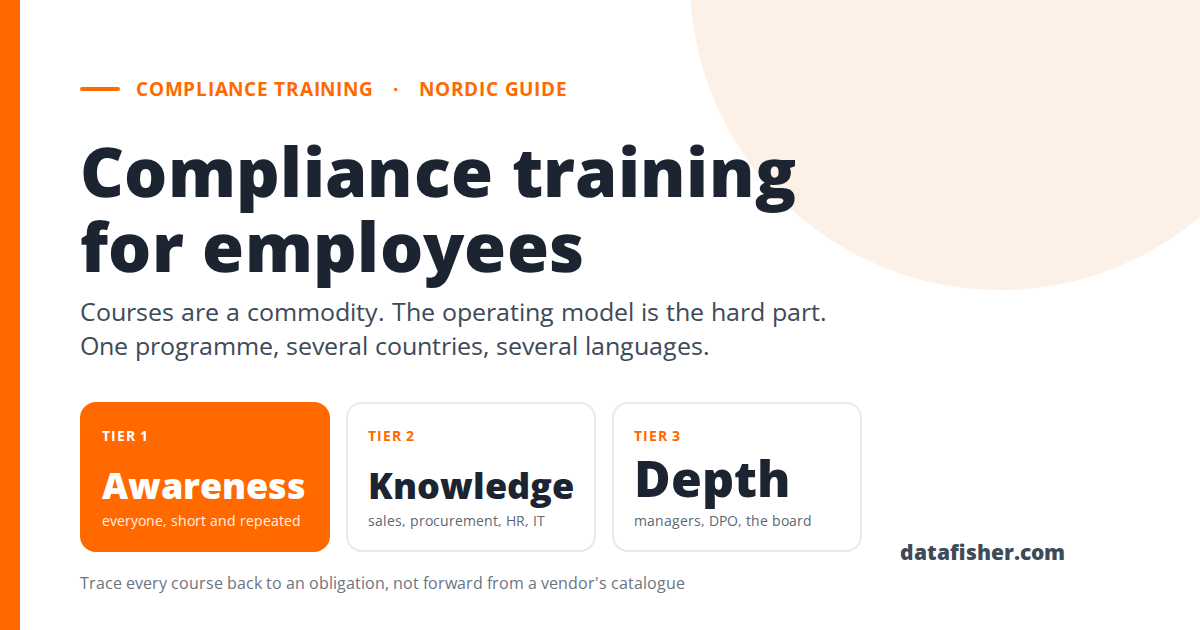
Compliance Training for Employees: A Complete Nordic Guide
Compliance Training for Employees: A Complete Nordic Guide The hard part of compliance training in a Nordic company is almost never the content. Courses on bribery, data protection and security awareness are commodities, available from a dozen vendors and largely interchangeable in substance. The hard part is the operating model. Which entity owns the programme. Which language each employee is entitled to receive it in. How employee representatives are involved before it launches. How completion is documented across countries with different supervisors asking for different evidence. Whether...
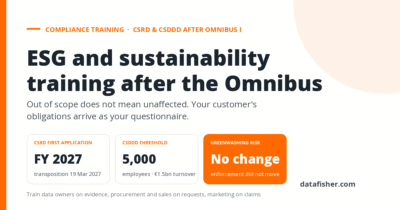
ESG and Sustainability Compliance Training After the Omnibus
ESG and Sustainability Compliance Training After the Omnibus Two years of preparation, then a rewrite. A great many Nordic companies built sustainability reporting capability through 2024 and 2025 on the assumption that CSRD applied to them, and then discovered in early 2026 that it might not. The confusion is the commercial opportunity here. Clarity is the product, and almost nothing published on this topic states the current position cleanly. In this guide What the Omnibus actually did Why out of scope does not mean unaffected What sustainability training actually needs to cover Roles that...
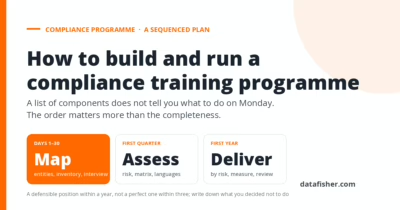
How to Build and Run a Compliance Training Programme
How to Build and Run a Compliance Training Programme Most guidance on compliance programmes is a list of components. Risk assessment, policies, training, a reporting channel, monitoring, review. All correct, all useless to the person who actually has the job, because a list does not tell you what to do on Monday. This is written for that person: someone who has just taken responsibility for compliance at an organisation that has grown past the point where informal management works, who has other duties as well, and who needs a defensible position within a year rather than a perfect one...
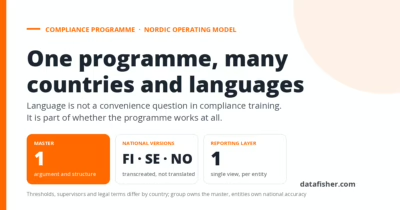
One Compliance Programme, Many Countries and Languages: A Nordic Operating Model
One Compliance Programme, Many Countries and Languages: A Nordic Operating Model Most groups discover the problem the same way. A compliance manager in Helsinki or Stockholm is asked how many people have completed the anti-bribery course, and finds that the answer exists in three systems, in two languages, against three different versions of the course, and cannot be reconciled into one number that anyone would defend in front of an auditor. Underneath that reporting problem sits a legal one that is less visible and considerably more serious. Compliance training exists to discharge an...
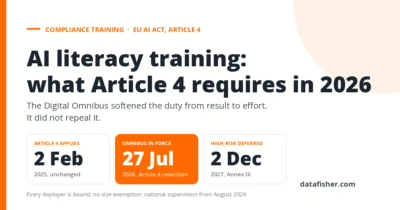
AI Literacy Training Under the EU AI Act: What Article 4 Requires in 2026
AI Literacy Training Under the EU AI Act: What Article 4 Requires in 2026 Every organisation in the EU that uses an AI system has been under a legal duty to see to the AI literacy of its staff since 2 February 2025. That duty did not go away this summer. It was rewritten, softened in one specific respect, and then handed to national supervisors who gained their enforcement powers in the first days of August 2026. If you have been waiting for the law to settle before doing anything, it has now settled, and the answer is that you have an obligation. The confusion is understandable. Between...
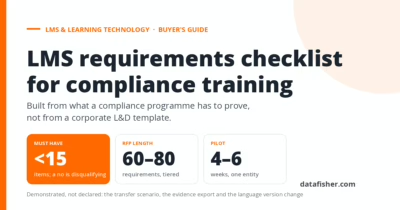
LMS requirements checklist for compliance training
LMS requirements checklist for compliance training Most LMS requirement templates in circulation were written for corporate learning and development. They ask about course catalogues, gamification, social features and mobile learning. They are not wrong, they are just answering a different brief, and a compliance buyer who uses one ends up scoring vendors on things that will never matter and missing the two or three that will. This is a requirement list built the other way round, starting from what a compliance programme has to be able to prove. Use it as the spine of an RFP or as a...
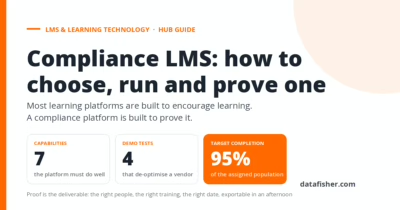
Compliance LMS: how to choose, run and prove one
Compliance LMS: how to choose, run and prove one Most learning platforms are built to encourage learning. A compliance platform is built to prove it. That single difference decides almost everything else about the product: how it handles enrolment, what it does when someone leaves the company, whether a completion record survives a licence change, and whether you can hand a supervisor an export without spending a week rebuilding it in a spreadsheet. If you are buying for a compliance programme rather than for professional development, most of the market is answering a question you did not...
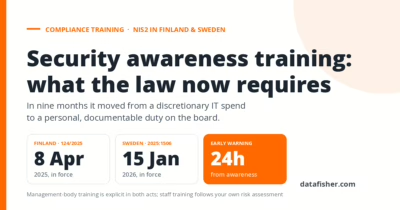
Security Awareness Training in the Nordics: What the Law Now Requires
Security Awareness Training in the Nordics: What the Law Now Requires For twenty years, security awareness training was a discretionary spend justified by risk arguments and bought by people who had to persuade a finance director. In the space of nine months across 2025 and 2026, it became a legal obligation in both Finland and Sweden, with a named duty holder and personal consequences for failure. That is the change worth understanding, because it moved the buying decision from IT to the board, and because most of the content published on this topic is still marketing for phishing...
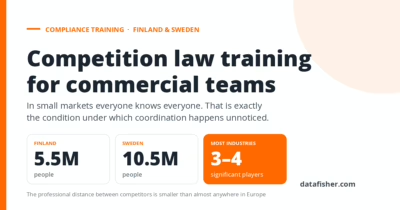
Competition Law Compliance Training for Commercial Teams
Competition Law Compliance Training for Commercial Teams Competition law training in the Nordics has a specific problem that international courses do not address, and it is not a legal problem. It is arithmetic. Finland has five and a half million people. Sweden has ten and a half. Most industries in either country support three or four significant players. Those players sit on the same trade association boards, employ each other's former staff, compete for the same public tenders, meet at the same conferences, and in many sectors know each other personally. The professional and social...
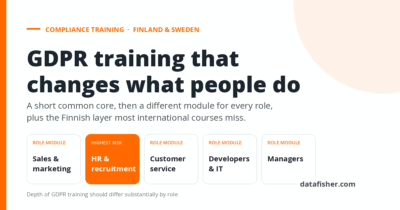
GDPR Training by Role: A Finnish and Swedish Guide
GDPR Training by Role: A Finnish and Swedish Guide Most GDPR training is organised around the regulation. It starts with the principles in Article 5, moves through lawful bases, covers data subject rights, and ends with a quiz. Employees complete it, score well, and then, three weeks later, export a customer list to a personal spreadsheet to work on at home. That gap is not a knowledge problem. It is a mapping problem. The employee learned the principles and never learned which of the specific things they do every day the principles apply to. Training organised around the law teaches the...
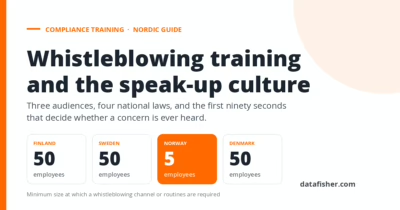
Whistleblowing Training and the Speak-Up Culture: A Nordic Guide
Whistleblowing Training and the Speak-Up Culture: A Nordic Guide Most organisations above fifty employees in Finland and Sweden now have a whistleblowing channel. They bought one because the law required it, they published a link on the intranet, and a meaningful proportion of them have received almost nothing through it since. That silence is usually read as good news. It is more often a measurement failure. People are still raising concerns, they are raising them to their line manager in a corridor, and whether anything happens next depends entirely on how that manager reacts in the first...

Why Integrity, Trust, and Fairness Still Matter — and Why Profit Is Part of Doing Good
You do not need to be an activist to have good values like Integrity, trust & fairness. Read about it in our latest blog.

Why Creating E-Learning With Authoring Tools Feels So Hard (And What To Do About It)
For many training professionals, the idea of transforming their classroom workshops into engaging e-learning modules sounds straightforward: you already have the content, so all that’s left is putting it online. But once you open up an authoring tool, reality sets in. What should have been simple suddenly feels overwhelming. Let’s break down why this happens — and what can help. 1. The Tool Feels Too Complicated Most authoring tools are designed with powerful features, but they often bury them in layers of menus and technical jargon. For a trainer whose expertise is in teaching...

Quick & Easy authoring tool – Turn Your PowerPoints into Great E-Learnings with Datafisher TooL
Creating effective e-learnings doesn’t have to be complex, expensive, or time-consuming. In fact, if your organisation already uses PowerPoint presentations for training, you’re more than halfway there. With Datafisher TooL, you can transform your existing slides into engaging, SCORM 2004-compliant e-learning modules in just a few simple steps. Why Start with PowerPoint? Many companies already use PowerPoint as the foundation for their internal trainings – whether it’s for compliance, onboarding, safety, or product training. These presentations often contain the key messages...

How to Use Your LMS for Training Externals, Vendors, Subcontractors, and Clients
In today’s interconnected business environment, training doesn’t stop at the borders of your organization. From vendors and subcontractors to partners and clients, external stakeholders often play a critical role in your company’s success. Whether you need to ensure compliance, promote product knowledge, or build trust in your brand, extending training beyond your internal workforce is both a strategic advantage and, increasingly, a necessity. A modern Learning Management System (LMS) can be your best ally in scaling and streamlining this kind of external training. Here's how. 1....

Why Tailored Compliance Training That Fits Your Company Culture Beats Off-the-Shelf Solutions
When it comes to compliance training, many organizations default to off-the-shelf solutions. They’re fast, affordable, and readily available. But while these pre-packaged modules may check a box, they often miss a critical mark: your company culture. At a time when compliance risks are increasingly tied to human behavior, a generic training course simply isn't always enough. Employees need to not only understand the rules—they need to feel that the rules matter within the context of your company. That’s where tailored compliance training becomes a strategic advantage. 1. Reinforces...

Why a Simple Authoring Tool Is Often More Than Enough?
In many organizations, valuable knowledge is already out there — tucked away in PowerPoint decks, team presentations, or training sessions that only live in someone’s local folder. The problem? It’s not being shared widely, reused effectively, or turned into structured learning. That’s where a simple authoring tool comes in — and why it might be exactly what your organization needs. You Already Have Great Content — Use It One of the biggest misconceptions about e-learning is that it has to be flashy, complex, and time-consuming to create. But the truth is, most teams already...