
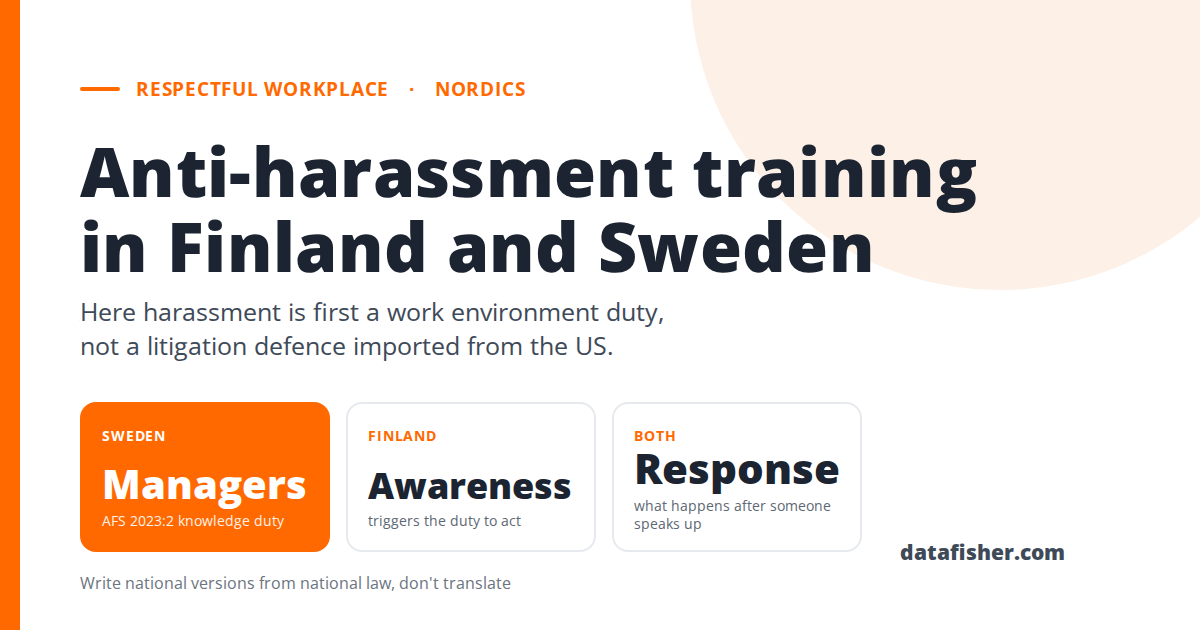
Anti-Harassment Training in the Nordics: What Finnish and Swedish Law Actually Requires
If your anti-harassment training was written in the United States, it is built on a legal theory that does not apply to you. In Finland and Sweden, harassment is first a question of occupational health and safety, and that changes what the training must contain.
American harassment training exists largely to establish an employer defence in discrimination litigation. It is organised around protected categories, around what constitutes a hostile work environment, and around demonstrating that the employer took reasonable care.
Nordic employers are not primarily regulated that way. In Finland and Sweden, harassment is governed by work environment law, supervised by work environment authorities, and framed as a duty to prevent risks to employee health. Discrimination law applies too and adds obligations, but it is the second frame rather than the first.
That is not a technicality. It changes who supervises you, what they inspect, what your workplace harassment training must contain, and what evidence you need to hold. This guide covers the Swedish and Finnish rules, the terminology that translated courses get wrong, who needs which training, and what the evidence says about whether it works.
Sweden: the manager knowledge duty
Sweden restructured its work environment regulations with effect from 1 January 2025, replacing sixty-seven separate föreskrifter (provisions) with fifteen. The organisational and social work environment rules previously found in AFS 2015:4 now sit within AFS 2023:2, alongside AFS 2023:1 on systematic work environment management.
The substance carried over largely intact, and one requirement in it matters more than anything else for anyone buying or designing training.
The employer must ensure that managers and supervisors have knowledge of how to prevent and handle unhealthy workload and kränkande särbehandling, and must ensure there are conditions to put that knowledge into practice.
That is an explicit regulatory training duty, directed at a defined population, in force now. It is not satisfied by an all-staff e-learning module that managers also happened to complete. Alongside it, the employer must make clear that kränkande särbehandling is not accepted and must have procedures for how it is reported, investigated and remedied, with written goals and routines required for employers with more than ten employees.
Layered on top, the Discrimination Act (2008:567) imposes duties on trakasserier and sexuella trakasserier (harassment and sexual harassment), including an obligation to investigate and take measures once the employer becomes aware, and continuous active measures obligations. The Equality Ombudsman (DO) supervises that side; Arbetsmiljöverket, the Swedish Work Environment Authority, supervises the work environment side.
Finland: the duty triggered by awareness
Finland approaches the same territory through the Occupational Safety and Health Act (738/2002). It places a duty on the employer to take measures to eliminate harassment or other inappropriate treatment once it becomes aware of behaviour causing hazard or harm to an employee’s health.
The trigger is awareness, and the standard is action. Supervision sits with the national occupational safety and health authority, now the occupational safety and health division of Lupa- ja valvontavirasto, which is the body an employee will contact if nothing happens.
Two further layers apply. The Act on Equality between Women and Men (609/1986) imposes a specific duty on the employer to act on sexual harassment once aware, supervised by the Ombudsman for Equality. The Non-Discrimination Act (1325/2014) covers harassment on other grounds, supervised by the Non-Discrimination Ombudsman. A single incident can therefore engage the occupational safety authority and one of two ombudsmen at the same time, and the employer’s duties under each are related but not identical.
The terminology problem
This is where translated training fails visibly, and it is worth explaining to employees rather than papering over. Four terms do different legal work:
Kränkande särbehandling. A defined Swedish work environment concept: actions directed at one or more employees in an offensive manner which may lead to ill health or to their exclusion from the workplace community. It does not require a discrimination ground.
Trakasserier. Harassment under the Swedish Discrimination Act, which requires a connection to a protected ground. Different concept, different law, different supervisor.
Häirintä. Harassment in Finnish occupational safety law, covering ground that is related to, but not identical with, either Swedish term.
Epäasiallinen kohtelu. Inappropriate treatment in Finnish occupational safety law. It has no clean English equivalent, and its scope is wider than what most English-language courses call harassment.
Translating all four into the English word “harassment” loses the legal content of each. A Swedish manager trained on “harassment” will not recognise that she is subject to a duty concerning kränkande särbehandling, and she may conclude that because no discrimination ground is involved, no obligation applies. That conclusion is wrong, and the training caused it.
This is the clearest case for national versions written from national law rather than translated from a global master. Good training states the distinction openly, so that managers and employees learn the terms they will actually meet in their own workplace rules and in any inspection.
Who needs which training
Workplace harassment training is not one course for everyone. Bullying and harassment training needs to be layered by role:
Managers and supervisors. The priority population, and in Sweden the requirement is explicit. They need to recognise the behaviours, understand that their awareness triggers the employer’s duty, know what to do in the first conversation, know that they must not investigate it themselves, and understand interim measures and how not to disadvantage the person who raised the concern.
All employees. A shorter module: what the behaviours are, that raising a concern is expected rather than merely tolerated, how to raise it, including alternative routes if the concern is about their own manager, and that retaliation is prohibited.
Investigators and HR. Procedural competence: impartiality, evidence, interviewing both parties, documentation written in the knowledge it may be read by those involved, and how to reach a conclusion when the facts are contested, which is most of the time.
Senior management. The governance picture, since the systematic work environment duty is theirs and the written goals and routines are theirs to approve.
What anti-harassment training must actually contain
Behaviours, not definitions. Employees do not need to recite the statutory formulation. They need to recognise a pattern of exclusion, persistent undermining in meetings, withheld information, comments that are individually deniable and cumulatively corrosive, and the difference between those and ordinary managerial direction.
The line between a demanding manager and unacceptable treatment. This deserves direct treatment, because it is the question everyone actually has. Legitimate management action, including performance criticism, task allocation and organisational change, is not kränkande särbehandling or epäasiallinen kohtelu merely because it is unwelcome. Saying this plainly makes the training credible; avoiding it makes managers defensive and employees cynical.
Reporting routes. Including what happens next and how long it takes.
Confidentiality. What the employer will and will not do, honestly stated.
Retaliation. Including the subtle forms, and the fact that adverse decisions affecting someone who has raised a concern will be scrutinised.
Sexual harassment training belongs inside this structure rather than beside it. In both countries sexual harassment carries its own duties under equality and discrimination law, but the same reporting routes, manager response and documentation apply.
Documentation regulators look for
Both regimes reward the same file:
Written goals and routines. Approved by management and known to staff.
Evidence of manager training. Proof that managers have received the knowledge required, documented as its own item in Sweden rather than aggregated into general completion figures.
Case records. Concerns raised, what was assessed, what was decided and when.
Risk assessment. Psychosocial factors covered as part of systematic work environment management.
Two things regulators look for that organisations frequently cannot produce: evidence that managers were trained specifically, and evidence that a concern raised eighteen months ago was actually followed up.
Does anti-harassment training work?
Compliance and HR buyers have read the same research we have, so it is worth being direct. The evidence that traditional harassment awareness training changes behaviour is mixed at best, and some studies suggest poorly designed training can produce backlash. A course that overclaims will lose the people it is meant to persuade.
What has better support is training that focuses on manager response competence, on bystander action, and on the organisation’s demonstrated handling of cases. In other words, the training that works is about what happens after someone speaks up, not about defining the offence.
That is also exactly what the Swedish manager knowledge duty requires. Build your anti-harassment training around manager response, national terminology and a documented follow-up trail, and you meet the regulator and the research at the same time.
Frequently asked questions
Is anti-harassment training mandatory in Sweden?
AFS 2023:2 requires employers to ensure that managers and supervisors have knowledge of how to prevent and handle kränkande särbehandling, and the conditions to apply it. That is a training obligation directed at a defined group.
What is kränkande särbehandling?
A defined Swedish work environment concept covering actions directed at one or more employees in an offensive manner that may lead to ill health or exclusion from the workplace community. It does not require a discrimination ground and is not a synonym for harassment.
What are a Finnish employer’s obligations on harassment?
Under the Occupational Safety and Health Act, the employer must take measures to eliminate harassment or inappropriate treatment once aware of behaviour causing hazard or harm to health. Additional duties arise under the Equality Act and the Non-Discrimination Act.
Who is responsible for preventing harassment in the workplace?
The employer. In Sweden, Arbetsmiljöverket supervises the work environment duties and the Equality Ombudsman supervises discrimination duties. In Finland, the occupational safety and health authority supervises, alongside the Ombudsman for Equality and the Non-Discrimination Ombudsman.
Is a demanding manager committing harassment?
Legitimate management action is not, even when unwelcome. The assessment turns on whether conduct is directed at a person in an offensive manner and risks ill health or exclusion from the workplace community.
Can we use our US parent company’s harassment training?
It will be built on a different legal theory, will use terminology that does not map onto Finnish or Swedish legal concepts, and will not address the Swedish manager knowledge duty. Rewrite from national law rather than translating.
Does anti-harassment training actually reduce harassment?
The evidence on traditional awareness training is mixed. Training focused on manager response competence and bystander action has better support, and it happens to be what the Swedish rules require.
Sources and further reading
- AFS 2023:2 Planering och organisering av arbetsmiljöarbete – Arbetsmiljöverket, in force 1 January 2025, includes the rules on kränkande särbehandling and manager knowledge
- Kränkande särbehandling och mobbning – Arbetsmiljöverket, definition and employer responsibilities
- Diskrimineringslag (2008:567) – Sveriges riksdag, duty to investigate harassment and active measures
- För arbetsgivare och utbildningsanordnare – Diskrimineringsombudsmannen (DO), employer guidance on harassment and active measures
- Työturvallisuuslaki 738/2002 – Finlex, Finnish Occupational Safety and Health Act, section 28 on harassment
- Laki naisten ja miesten välisestä tasa-arvosta 609/1986 – Finlex, Act on Equality between Women and Men
- Yhdenvertaisuuslaki 1325/2014 – Finlex, Non-Discrimination Act
- Epäasiallinen kohtelu – Työsuojeluhallinto, employer duties once aware of harassment or inappropriate treatment
Related articles
 AML Training for Non-Specialist Teams: What the Front Line Needs to Know
 Anti-Bribery Training: A Practical Nordic Guide to Anti-Corruption
 How Often Is Compliance Training Required? Setting a Defensible Frequency
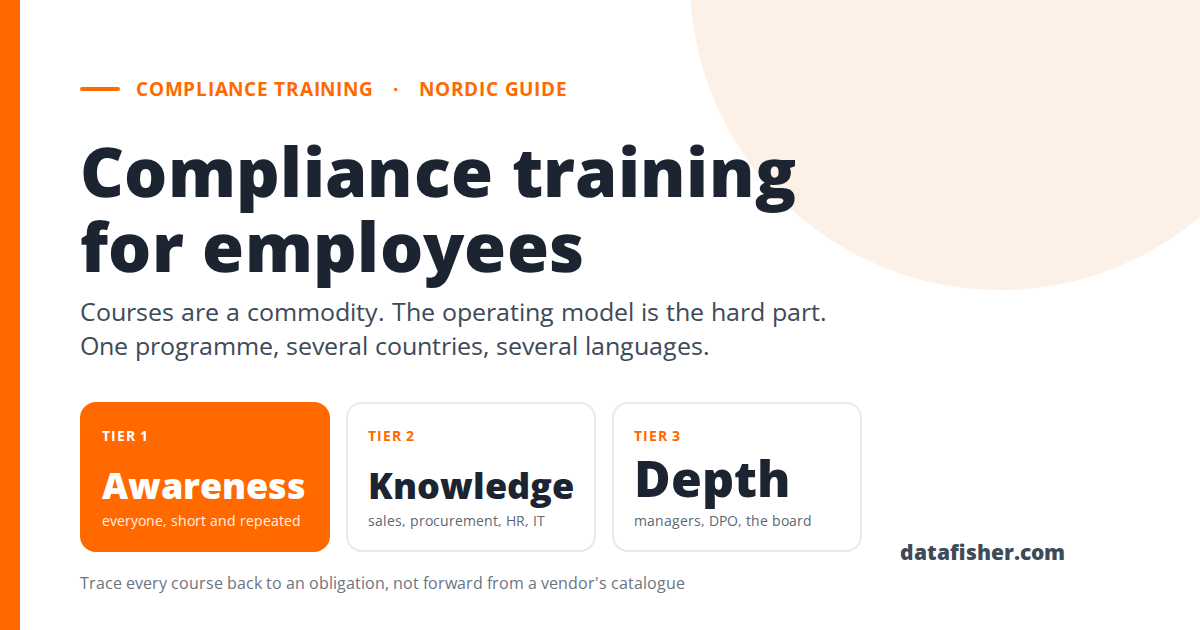 Compliance Training for Employees: A Complete Nordic Guide
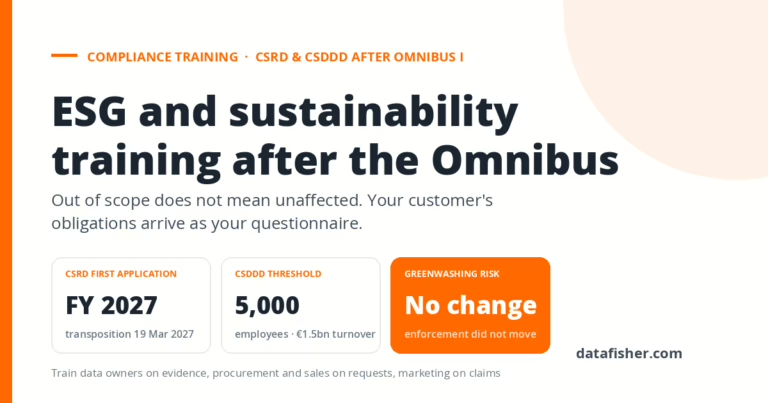 ESG and Sustainability Compliance Training After the Omnibus
 How to Build and Run a Compliance Training Programme
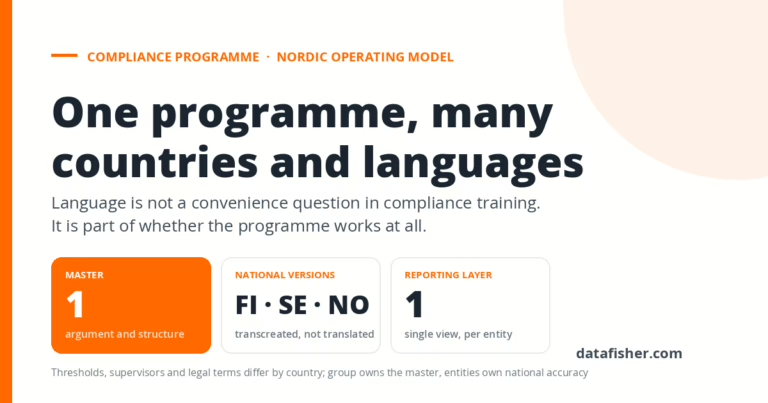 One Compliance Programme, Many Countries and Languages: A Nordic Operating Model
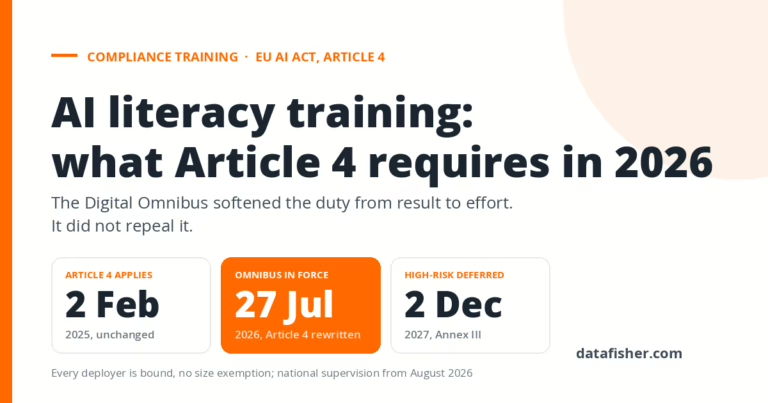 AI Literacy Training Under the EU AI Act: What Article 4 Requires in 2026
 LMS requirements checklist for compliance training