
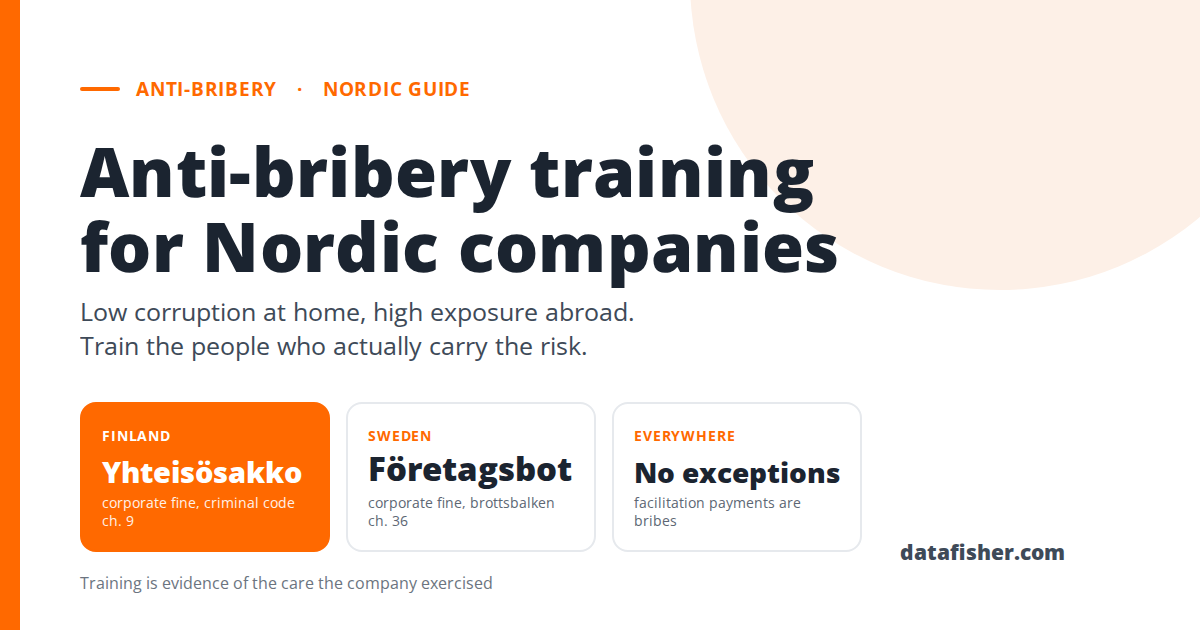
Anti-Bribery Training: A Practical Nordic Guide to Anti-Corruption
Search for anti-bribery training in English and almost everything you find is built on the UK Bribery Act. It describes the legal position of a company in London. It does not describe the position of a company in Helsinki or Stockholm, and building your anti-corruption programme on it means building it on a defence you cannot plead.
The typical guide explains the offences, then the adequate procedures defence, then explains that training is one of the six principles that make up adequate procedures. It is a coherent argument. This guide sets out what Finnish and Swedish law actually asks of a company, where Nordic bribery risk really sits, and how to design anti-bribery and anti-corruption training for the people who carry that risk.
How Nordic bribery exposure actually works
Neither Finland nor Sweden operates a statutory defence of the UK type, where a company that can demonstrate adequate procedures is protected from liability for an associated person’s bribery. What both operate instead is corporate criminal liability.
In Finland this is the corporate fine, yhteisösakko, under chapter 9 of the Criminal Code. A company can be liable where an offence has been committed in its operations and where its management has participated in, permitted, or failed to exercise the care required to prevent the offence. The bribery offences themselves sit in chapter 16, covering bribery of officials, and in chapter 30, covering bribery in business.
In Sweden the equivalent is the corporate fine, företagsbot, under chapter 36 of the Swedish Criminal Code, with the bribery offences, mutbrott, in chapter 10. Swedish corporate fine levels were raised significantly for larger undertakings in the reform of recent years, which changed the commercial calculus considerably.
The distinction matters for how you frame anti-bribery training internally. Under an adequate procedures regime, training is a component of a defence you assert after the fact. Under a corporate criminal liability regime, training is evidence of the care the company exercised, and the question a prosecutor asks is not whether you had a programme but whether the company did what could reasonably be expected of it in the circumstances.
Those are different questions and they produce different programmes. The first rewards documentation of coverage. The second rewards demonstrable relevance to the actual risk.
Low corruption at home, high exposure abroad
Finland and Sweden both rank near the top of Transparency International’s Corruption Perceptions Index, and both have nonetheless produced significant foreign bribery cases involving well-known companies.
That combination is the single most useful framing for a Nordic audience, and it is the opposite of what employees intuitively believe. The risk is not concentrated in the home office, where corruption is genuinely rare. It is concentrated in export markets, in intermediaries, and in the places where a Nordic company’s own culture stops being the operating culture.
The practical consequence is that the highest-exposure employees in a Nordic company are frequently not the ones a generic programme targets. They are the regional sales manager covering a difficult market, the logistics coordinator dealing with customs in a third country, the project manager on an infrastructure contract, and the person who selected the local agent because a customer recommended them.
A Nordic anti-bribery programme that spends most of its effort on head office and treats the export function as an afterthought has inverted its own risk assessment.
What counts as bribery, in plain terms
There are two categories, and employees confuse them constantly.
Bribery involving public officials. Offering, promising or giving a benefit to an official so that they act, or refrain from acting, in their duties. The assessment turns on the capacity of the benefit to influence, not on whether it did. Nordic public officials are themselves subject to stricter rules on what they may accept than private counterparties are, and that matters to you as the giver: the official’s rules constrain what you can offer, independently of your own policy.
Bribery in business, between private parties. Frequently underestimated. An improper benefit to an employee or agent of another company, to influence their commercial decision, is an offence in both countries. Employees who understand that officials are sensitive often assume the private sector is open, and it is not.
There is no de minimis carve-out that makes small payments acceptable, and no facilitation payment exception. Employees who have absorbed the American facilitation payment concept from a group policy or from the internet believe a permitted category exists. It does not.
Who needs anti-bribery training, and at what depth
Anti-bribery training for employees should be prioritised by exposure, not delivered at the same depth to everyone.
Sales and commercial teams operating outside the Nordics. They need the deepest treatment: agents and intermediaries, commissions, entertainment, public procurement, and the moment when a local partner explains how things work here.
Procurement. Procurement needs the mirror image, since receiving improper benefits is also an offence and procurement is where they are offered.
Logistics, export and customs staff. They need the facilitation payment position and a workable answer to the demand at the border, which is a safety question before it is a compliance question and which most policies handle badly.
Anyone selecting or managing third parties. They need due diligence, because most bribery risk enters the organisation at the point of partner selection, usually before compliance is consulted.
Finance. Finance needs the books and records dimension, since improper payments have to be disguised in the accounts and finance sees the disguise.
Senior management. Senior management needs the corporate liability picture and their own role in it.
Scenarios that reflect Nordic reality
Generic training uses cash in envelopes. Nordic employees have never seen that and correctly conclude the training is not about them. Use situations that actually occur.
The unusual commission. An agent in a third market proposes a commission structure that is unusually high or payable to an entity in a different country.
The customs fixer. A customs delay is resolved by a local fixer for a fee that appears on no invoice.
Hospitality the client cannot accept. A public-sector client in a Nordic country requests hospitality that your policy permits but their own rules prohibit.
The recommended consultant. A customer recommends a specific consultant and implies the contract depends on engaging them.
The unexplained discount. A distributor asks for a large discount with no explanation of where the margin goes.
The connected donation. A charitable donation is requested by an entity connected to a decision maker.
Each of these is realistic, each has a defensible answer, and each rewards the employee for pausing rather than for knowing a rule.
Gifts and hospitality: the Swedish reference point
Swedish practice has a genuine standard here that international courses miss. Institutet Mot Mutor publishes Näringslivskoden, the Swedish business code against corruption, whose rules on gifts, rewards and other benefits are the reference against which Swedish conduct is measured in practice.
Its logic is worth internalising because it is better than the fixed-limit approach most policies use. It works on reasonableness, openness and the relationship between the benefit and any pending decision, rather than on a euro figure. A benefit that is moderate, open, and unconnected to a decision under way is very different from an identical benefit offered during a tender.
Finland approaches the same territory through criminal law principles and Keskuskauppakamari guidance, with the same practical result: the amount is a triage tool, not the test.
Third parties
Most enforcement against companies concerns conduct by someone who was not an employee. Agents, distributors, consultants, customs brokers and joint venture partners create liability, and the company’s control over them is exercised at two moments: selection, and contract.
Training the compliance team on due diligence is necessary and insufficient. The intervention that changes outcomes is training the commercial team that selects partners, because by the time a due diligence questionnaire is issued, the sales director has usually already decided.
Records and evidence
Under a corporate liability regime, your records are the substance of the argument that the company exercised the care required. Keep:
The risk assessment. Show which markets, activities and roles you assessed as exposed, and why.
Training content with version dates. So you can show what each person was taught, and when.
Delivery records by role and by entity. Coverage that maps to the risk assessment, not a single completion percentage.
The gift and hospitality register and pre-approval decisions. These demonstrate a functioning control rather than a stated one.
Due diligence files on third parties. Evidence that partner selection was controlled, not just documented afterwards.
Build Nordic anti-bribery training around corporate criminal liability, not the UK adequate procedures defence: target the roles that carry export and third-party risk, use scenarios your people will recognise, and keep records that prove the care the company exercised.
Frequently asked questions
Is anti-bribery training a legal requirement in Finland or Sweden?
There is no express statutory duty to train in the way UK guidance implies. The driver is corporate criminal liability, where the question is whether the company exercised the care required to prevent the offence, and training is central evidence of that.
Who needs anti-bribery training?
Prioritise by exposure: commercial teams operating outside the Nordics, procurement, logistics and customs, anyone selecting third parties, finance, and senior management.
What are the main bribery offences in Finland and Sweden?
In Finland, bribery of officials sits in chapter 16 and bribery in business in chapter 30 of the Criminal Code. In Sweden, the bribery offences (mutbrott: giving and taking a bribe) are in chapter 10 of the Criminal Code. Both countries criminalise the giving and the taking of bribes.
What is the penalty for bribery in Finland?
Individuals face criminal penalties under the Criminal Code: according to the Finnish anti-corruption portal, a fine or up to two years’ imprisonment for the basic offence and four months to four years for aggravated bribery. Separately, the company can receive a corporate fine (yhteisösakko), generally between €850 and €850,000, where management participated in, permitted, or failed to prevent the offence.
What is the penalty for bribery in Sweden?
According to the Swedish Prosecution Authority, giving or taking a bribe is punishable by a fine or up to two years’ imprisonment, and by six months to six years for an aggravated offence. The company can also face a corporate fine (företagsbot) where the offence was committed in its business.
What is företagsbot?
The Swedish corporate fine under chapter 36 of the Criminal Code, imposed on undertakings for offences committed in their business. Maximum levels for larger undertakings were raised substantially in recent reform.
Does the UK Bribery Act apply to Nordic companies?
Only where there is a UK nexus. Building your programme on the adequate procedures defence is a mistake if your actual exposure is Finnish or Swedish corporate criminal liability.
Are facilitation payments allowed?
No. Neither Finnish nor Swedish law contains the narrow exception found in US law, and small payments to speed up routine official acts are bribes.
Is bribery between private companies an offence?
Yes, in both countries. Employees frequently assume only public officials are covered, which is wrong.
What is the Näringslivskoden?
The Swedish business code against corruption issued by Institutet Mot Mutor. Its rules on gifts, rewards and other benefits work on reasonableness and openness rather than fixed monetary limits, and it is the practical standard Swedish conduct is measured against.
Sources and further reading
- Rikoslaki 39/1889 (Finnish Criminal Code) – Finlex, Ministry of Justice; chapters 9 (corporate criminal liability), 16 and 30 (bribery offences)
- Brottsbalk (1962:700) (Swedish Criminal Code) – Sveriges riksdag; chapter 10 (bribery) and chapter 36 (företagsbot)
- Kansalliset lait ja korruptiontorjunta – Finnish government anti-corruption portal; bribery offences and penalties
- Yhteisösakon enimmäismäärään muutoksia – Finnish Government (2025); general corporate fine range
- Korruptionsbrott – Swedish Prosecution Authority; bribery offences and penalties
- Näringslivskoden – Institutet Mot Mutor; Swedish business code against corruption, including gifts and other benefits
- Corruption Perceptions Index – Transparency International
- Fighting foreign bribery – OECD; the Anti-Bribery Convention and foreign bribery enforcement
Related articles
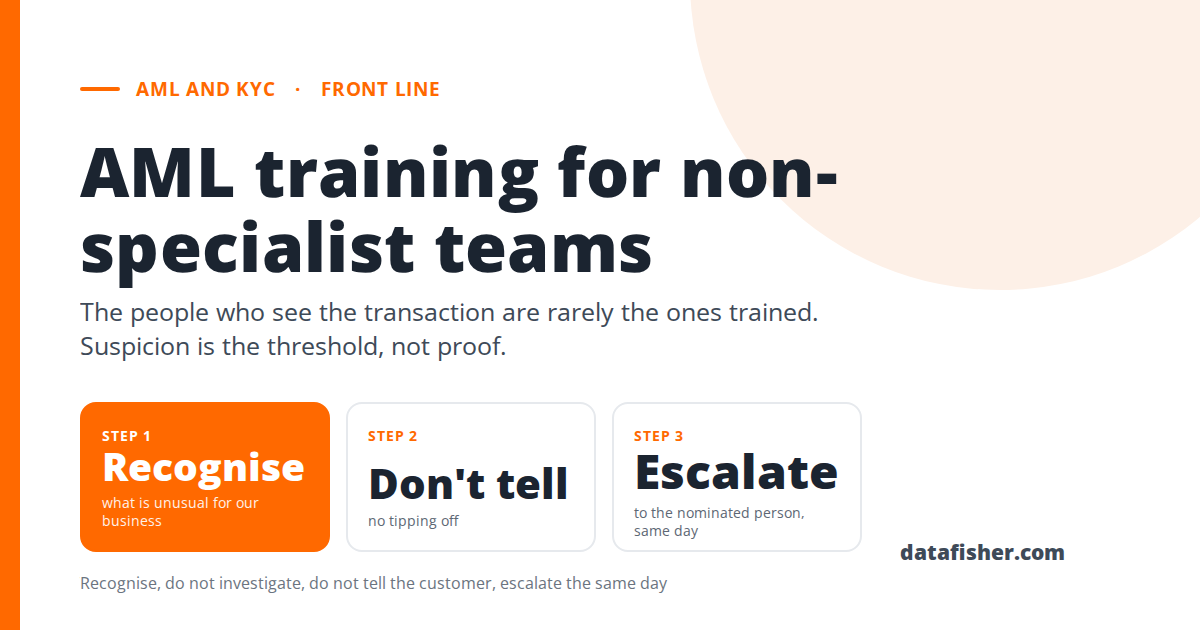 AML Training for Non-Specialist Teams: What the Front Line Needs to Know
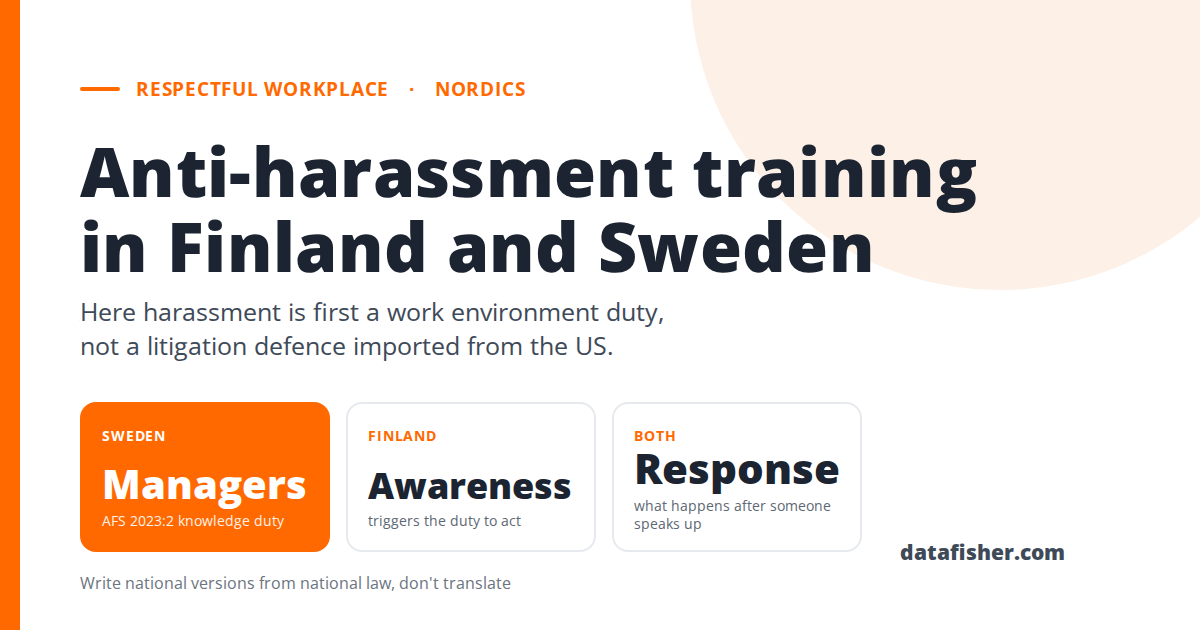 Anti-Harassment Training in the Nordics: What Finnish and Swedish Law Actually Requires
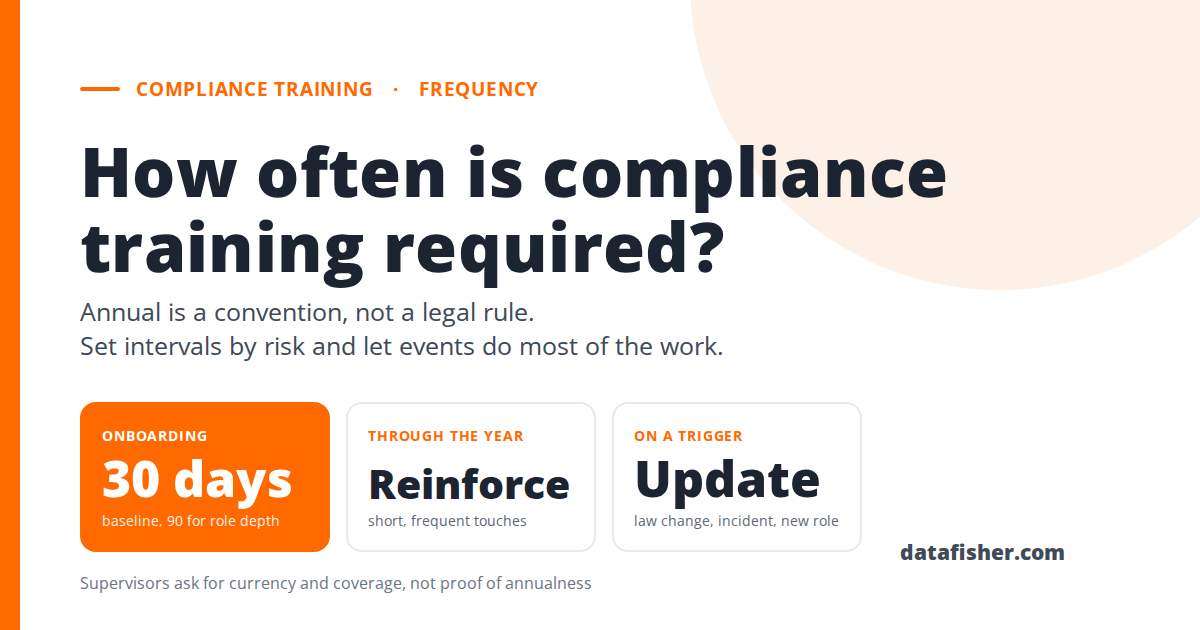 How Often Is Compliance Training Required? Setting a Defensible Frequency
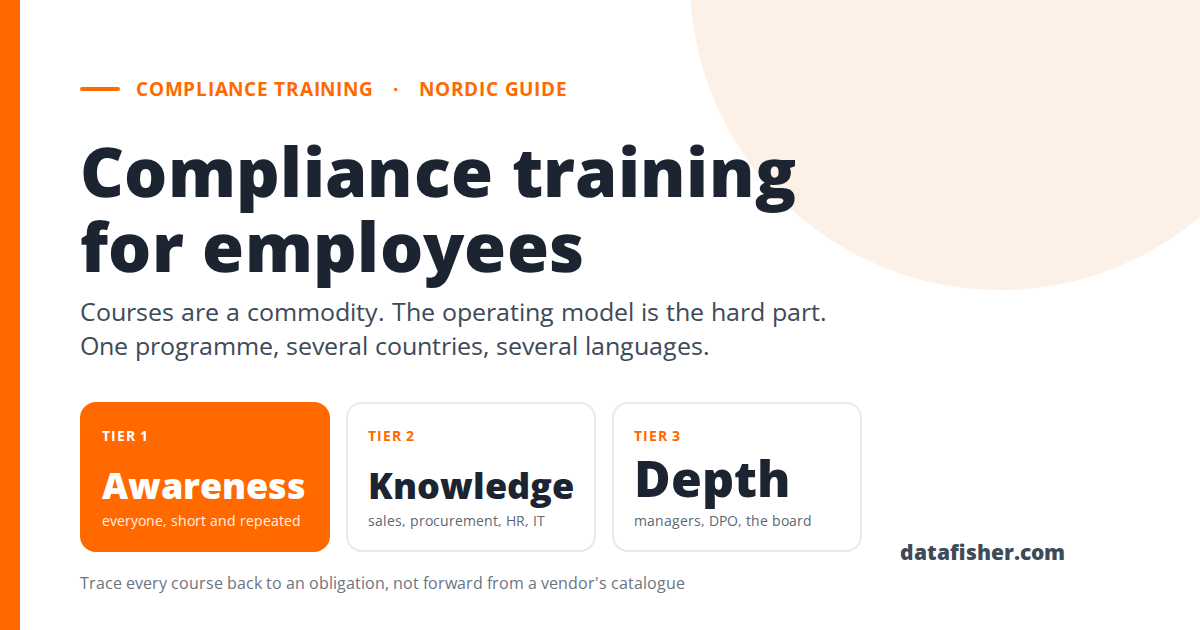 Compliance Training for Employees: A Complete Nordic Guide
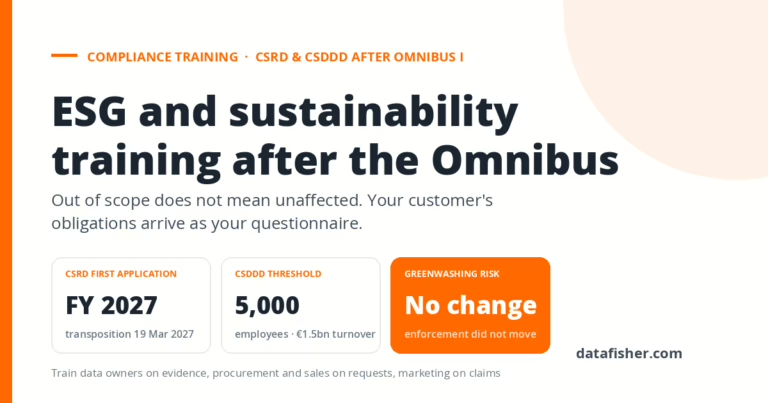 ESG and Sustainability Compliance Training After the Omnibus
 How to Build and Run a Compliance Training Programme
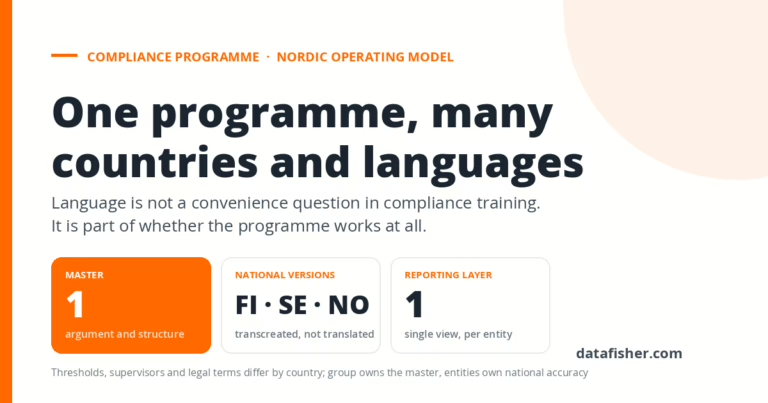 One Compliance Programme, Many Countries and Languages: A Nordic Operating Model
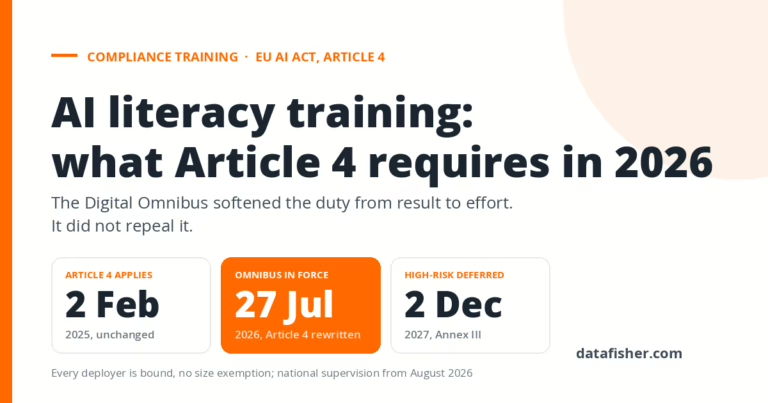 AI Literacy Training Under the EU AI Act: What Article 4 Requires in 2026
 LMS requirements checklist for compliance training