
How Often Is Compliance Training Required? Setting a Defensible Frequency
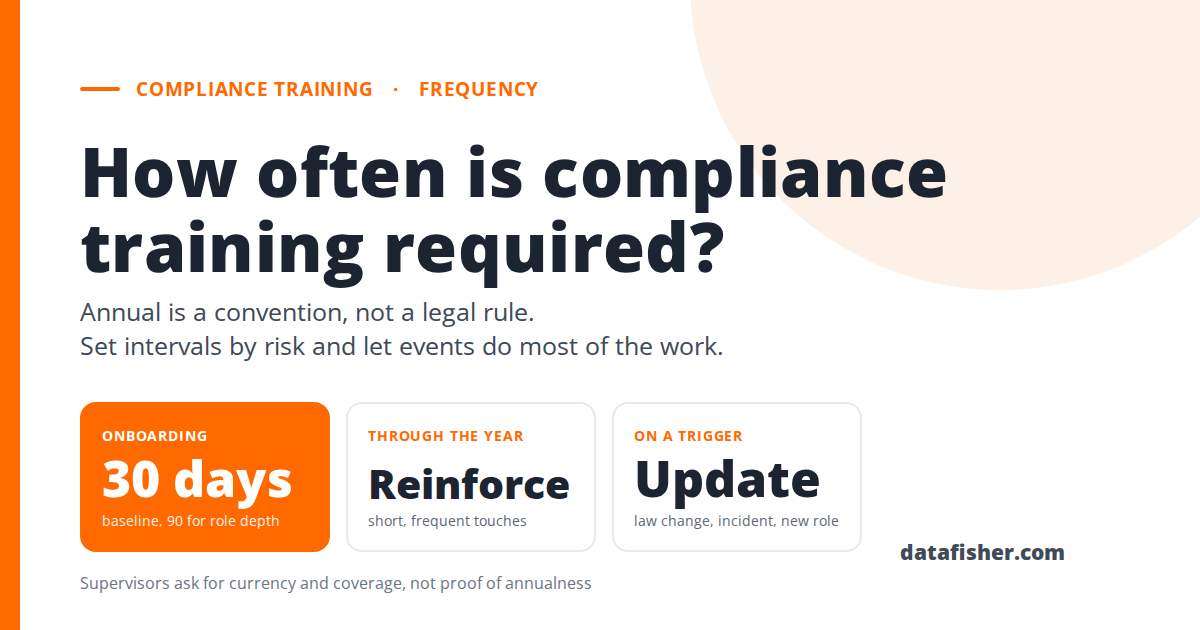
How often is compliance training required? The honest answer is that in most areas no law tells you, and anyone who gives you a confident number is describing a convention rather than a requirement.
That is worth saying plainly, because the internet is full of articles asserting that compliance training must be annual. It must not. Annual compliance training is what most organisations do, largely because HR systems and audit cycles run annually, and it has been repeated often enough to sound like a rule.
What matters instead is that training is current, proportionate to risk, and evidenced. Those are the standards a supervisor actually applies, and they are satisfied by a defensible method for setting compliance training frequency rather than by a calendar entry.
How often is compliance training required by law?
In most areas, the law does not set an interval at all. What legislation generally requires is that training is appropriate to the person’s duties and kept current. The GDPR, for example, lists awareness-raising and training of staff among the data protection officer’s tasks, but sets no frequency.
Annual compliance training is a convention, not a legal rule. The standard you will be held to is whether training is current, risk-based and evidenced.
That does not mean anything goes. It means the frequency is yours to choose, and you need to be able to explain the choice.
The four cases where a cadence effectively exists
There are exceptions, and a Nordic organisation should know them precisely.
Management body cyber security training. Both Finland’s Cybersecurity Act (124/2025) and Sweden’s Cybersecurity Act (2025:1506) require members of the management body to have training sufficient to identify and assess cyber risks and oversee the measures they approve. Neither fixes an interval, but the duty attaches to individuals, which means it is triggered by appointment. In practice this creates a cadence: on appointment, and refreshed on a defined cycle thereafter, because a director trained in 2024 cannot credibly be said to have current knowledge of a framework that changed in 2025 and 2026.
AML training for obliged entities. National money laundering legislation in both countries, Finland’s Act on Preventing Money Laundering and Terrorist Financing (444/2017) and Sweden’s Money Laundering Act (2017:630), requires obliged entities to ensure staff receive training appropriate to their duties. The Swedish act (chapter 2, section 14) says this training must be ongoing. Supervisors read the duty as regular, role-appropriate and current, and the sector norm is annual with differentiated depth. Departing from that requires a reason you can articulate.
Financial services sector requirements. Where a firm is supervised by Finanssivalvonta or Finansinspektionen, sector rules and supervisory expectations add competence and training requirements beyond the general position, including for specific licensed roles.
Manager knowledge on workplace conduct in Sweden. The work environment regulations (AFS 2023:2) require the employer to ensure managers and supervisors know how to prevent and handle unhealthy workload and kränkande särbehandling (victimisation). There is no interval, but the duty is continuous and attaches to whoever holds the role, so it is triggered by promotion and by organisational change rather than by the calendar.
Note the pattern. Three of the four are triggered by events rather than by dates. That is the model worth generalising.
A risk-based method for setting compliance training frequency
Everywhere else, four inputs give you a defensible interval.
Baseline for everyone. A short recurring layer covering recognition and escalation. This should be frequent and brief rather than infrequent and long, because the objective is recall under pressure. Several short touches through the year outperform one long module, and there is no legal reason to prefer the latter.
Elevated frequency for exposed roles. Where a role creates recurring exposure, meaning commercial teams dealing with third parties, procurement, finance, HR, IT, and anyone client-facing in an obliged entity, both depth and frequency increase. The justification is your risk assessment, which is why the risk assessment has to exist before the calendar does.
Event triggers, which do most of the real work. These are the events that should force training regardless of when the last session was: a change in the law, new supervisory guidance, an incident inside the organisation, a near miss, an incident at a comparable company in your sector, a new product or market, a new system, a merger or acquisition, and any individual moving into an exposed role.
A documented review. Once a year, ask whether the programme still matches the risk picture and whether the content is still accurate. This is a governance step, not a delivery step, and it is what allows you to say the intervals were chosen rather than inherited.
Why annual refreshers underperform
There are two reasons, both of which have practical fixes.
Retention decays. Recognition of a situation encountered once in a module in October is measurably weaker by the following June, and the situations compliance training addresses are exactly the ones people meet rarely and must handle correctly.
New joiners wait up to eleven months. An annual campaign creates an eleven-month gap for people who join after it. In an organisation with 15 percent turnover, a meaningful share of the workforce at any moment has never received the training at all. Onboarding delivery inside a defined window fixes this, and it is frequently missing.
The fix is not more training. It is redistributing the same volume: substantive content at onboarding, short reinforcement spread through the year, and depth where risk sits.
Refresher training versus a full course
The two are worth distinguishing, because they answer different questions.
A full course establishes understanding and is appropriate at onboarding, on role change, and when the subject matter has materially changed. Refresher training tests and reinforces currency and can be very short. Treating every recurrence as a full course is the main reason employees experience compliance training as a burden, and burden produces click-through completion, which evidences nothing.
Where the law has changed, a refresher is not enough.
The AI Act obligations, the Nordic cyber security acts and the sustainability directives have all moved in the last two years, and organisations replaying 2024 content are training people on a superseded position.
How long is compliance training valid for?
Validity is a policy construct rather than a legal one in most areas. You decide that a course remains current for a period, and that decision is defensible if it is reasoned and documented.
What a supervisor tests is different. They ask whether the people involved in whatever prompted the inquiry had current, relevant training, and whether the organisation can show it. A twelve-month validity period is easy to administer and easy to defend. A three-year period may also be defensible for low-risk content in a stable area, provided you can explain why.
Compliance training for new employees and contractors
Set a defined window, measured from the start date, and enforce it. Thirty days for the baseline and ninety for role-specific depth is a common and defensible pattern.
Contractors and agency staff performing work that creates exposure need the same treatment, and they are the population most often missed entirely.
What supervisors actually ask for
Not proof of annualness. They look for evidence of currency and coverage: that the relevant people had relevant training, that it reflected the law as it stood, that it was delivered when you say it was, and that the intervals were chosen for a reason.
An organisation with a documented risk-based cadence and a nine-month cycle is in a stronger position than one with an undocumented annual habit, because the first can explain itself.
Frequently asked questions
How often is compliance training required?
In most areas no law sets a fixed interval. The law generally requires training that is appropriate to the role and current, so frequency should be set by risk, triggered by events, and documented.
Is annual compliance training a legal requirement?
No. Annual delivery is a widespread convention rather than a statutory rule in most areas. What the law generally requires is that training is appropriate and current.
How often do you have to do mandatory training?
It depends on the topic and your role, and in Finland and Sweden fixed intervals are rare. The nearest things to fixed cadences are management body cyber security training, AML training for obliged entities, financial sector requirements, and the Swedish duty to ensure managers have current knowledge on workplace conduct.
How frequently should training be conducted?
Short baseline touches several times a year for everyone, more depth and frequency for exposed roles, extra training whenever a trigger event occurs, and a documented review once a year.
How often does GDPR training need to be done?
The GDPR sets no interval. Set it by risk, with onboarding delivery, reinforcement through the year, and updates when your processing or your supervisory authority’s guidance changes.
How often is AML training required?
National legislation requires training appropriate to the role without fixing an interval; Swedish law adds that it must be ongoing. The sector norm is annual with role-differentiated depth, and departing from it needs a documented reason.
What is the difference between refresher training and a full course?
A full course establishes understanding, for onboarding, role change and material legal change. A refresher reinforces currency and can be very short. Treating every recurrence as a full course is why people disengage.
How long is compliance training valid for?
Validity is a policy decision rather than a legal one. Choose a period, document the reasoning, and be able to show the people involved had current training when it mattered.
Do new employees need compliance training immediately?
They need it within a defined and enforced window, commonly thirty days for baseline content and ninety for role-specific depth. Contractors doing exposed work need the same.
Does more frequent training mean better compliance?
Not by itself. Redistributing the same volume into shorter, more frequent touches with depth where risk sits outperforms adding hours.
Sources and further reading
- Cybersecurity Act 124/2025 – Finlex, Finland: management body training duty
- Cybersäkerhetslag (2025:1506) – Sveriges riksdag: Swedish cyber security act
- Act on Preventing Money Laundering and Terrorist Financing 444/2017 – Finlex, Finland: AML obligations of obliged entities
- Lag (2017:630) om åtgärder mot penningtvätt och finansiering av terrorism – Sveriges riksdag: ongoing staff training, chapter 2, section 14
- Prevention of money laundering and terrorist financing – Finanssivalvonta (FIN-FSA)
- Anti-money laundering and countering financing of terrorism – Finansinspektionen
- AFS 2023:2 Planering och organisering av arbetsmiljöarbete – Arbetsmiljöverket: manager knowledge on workload and victimisation
- Regulation (EU) 2016/679 (GDPR) – EUR-Lex: Article 39, awareness-raising and training of staff
Related articles
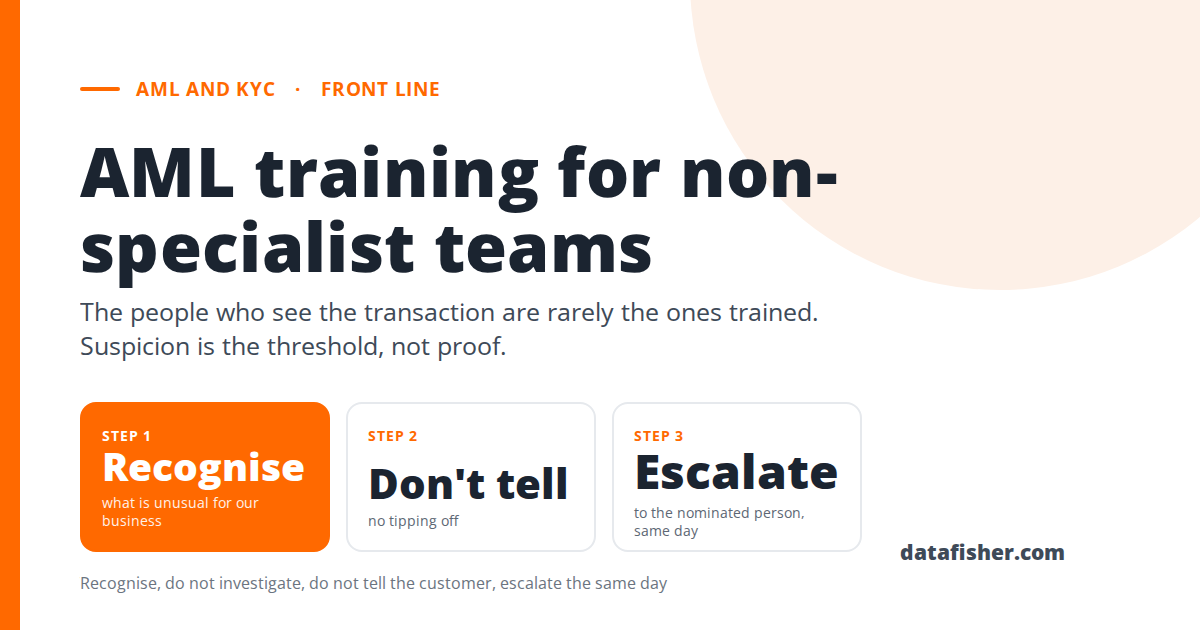 AML Training for Non-Specialist Teams: What the Front Line Needs to Know
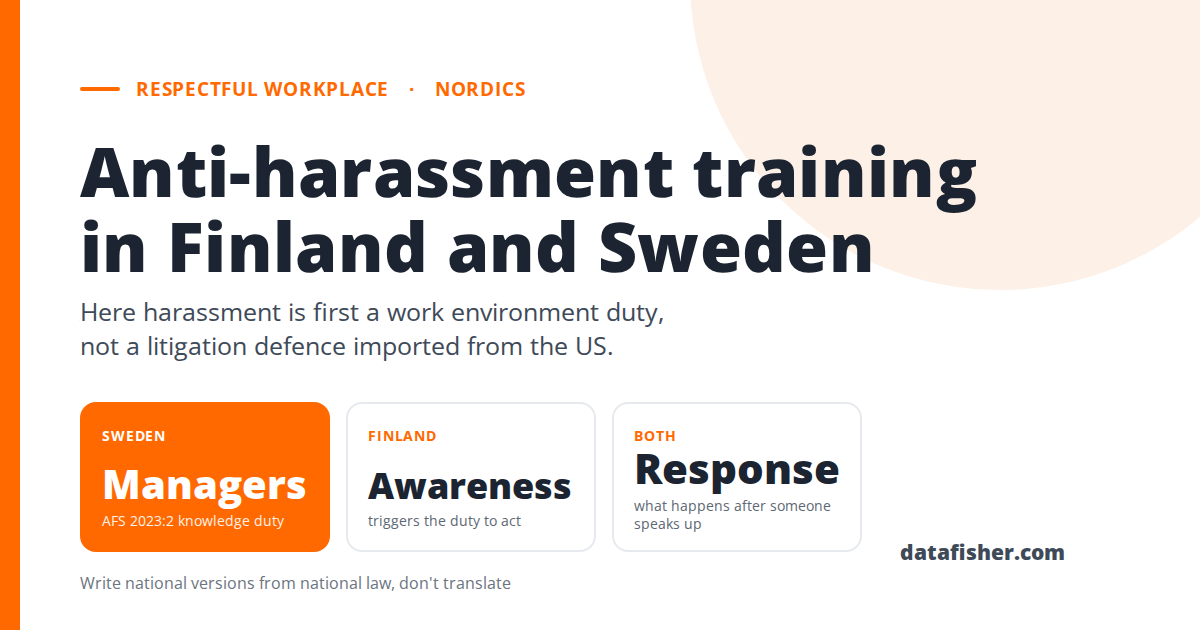 Anti-Harassment Training in the Nordics: What Finnish and Swedish Law Actually Requires
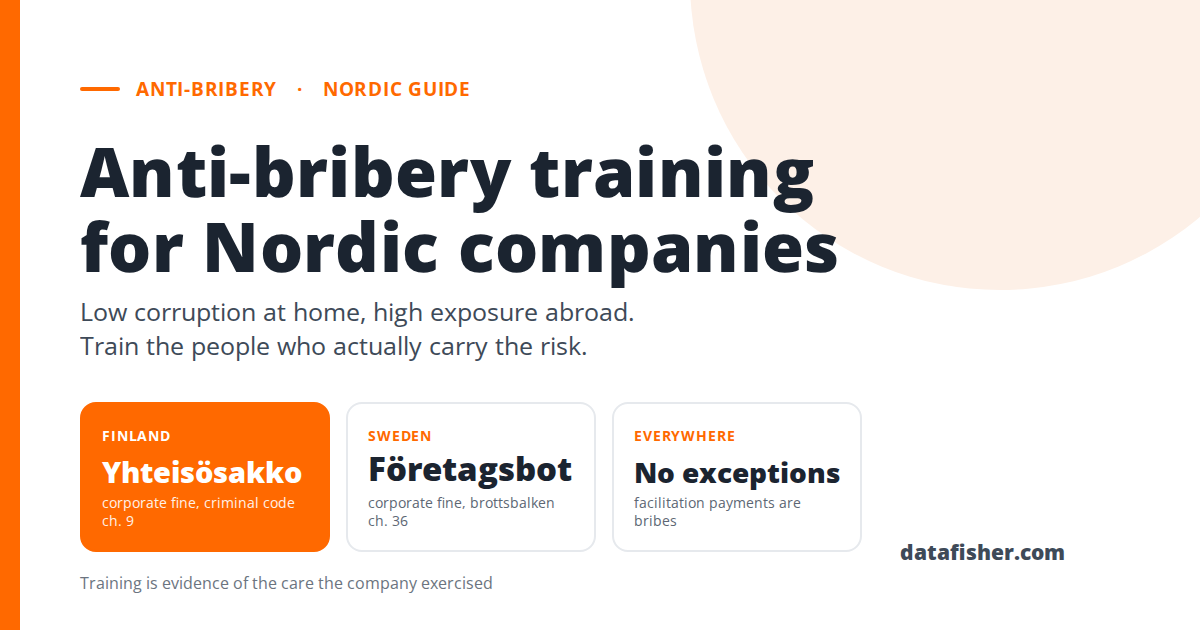 Anti-Bribery Training: A Practical Nordic Guide to Anti-Corruption
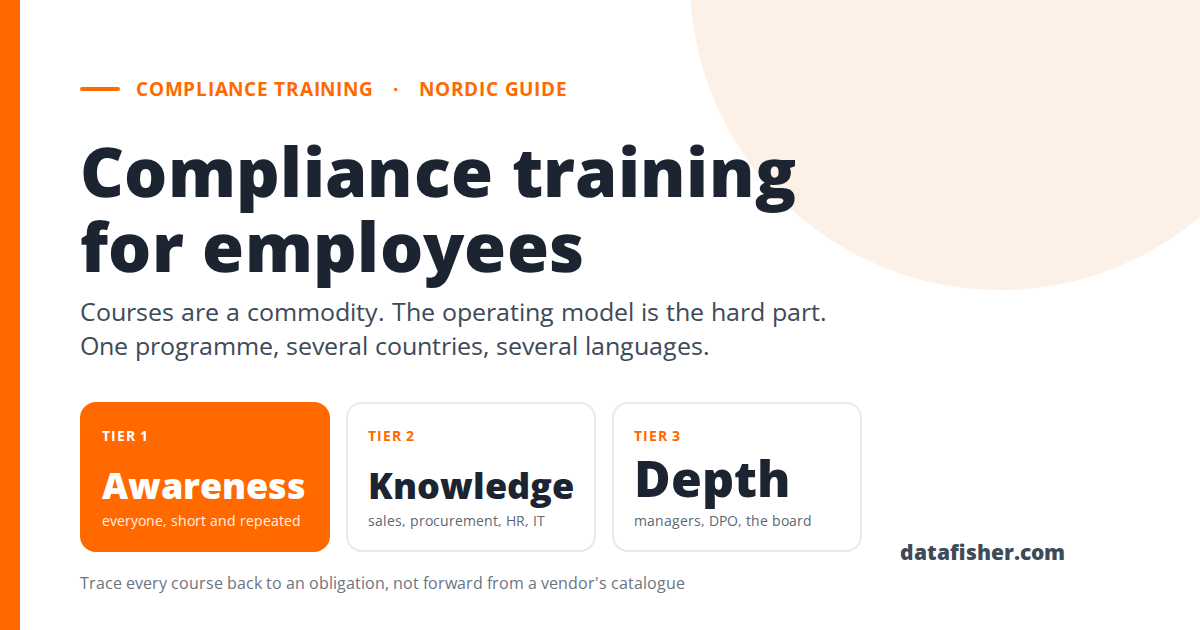 Compliance Training for Employees: A Complete Nordic Guide
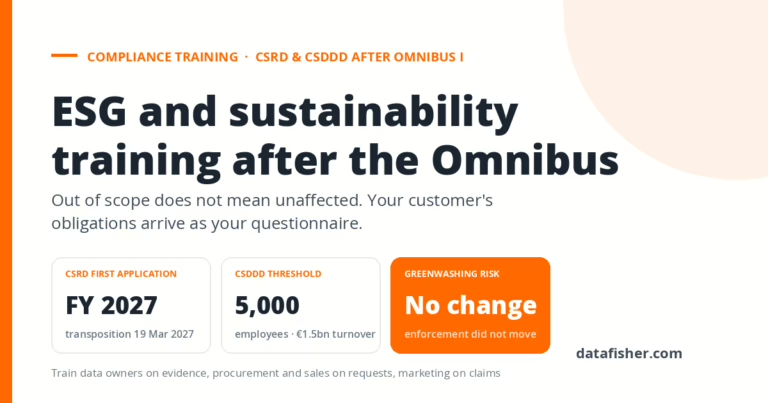 ESG and Sustainability Compliance Training After the Omnibus
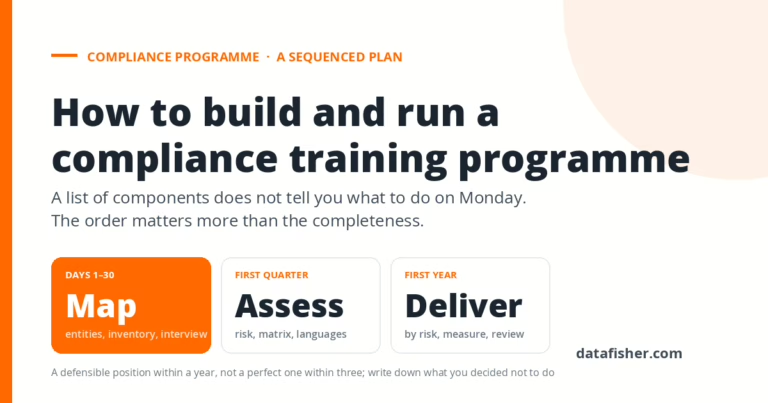 How to Build and Run a Compliance Training Programme
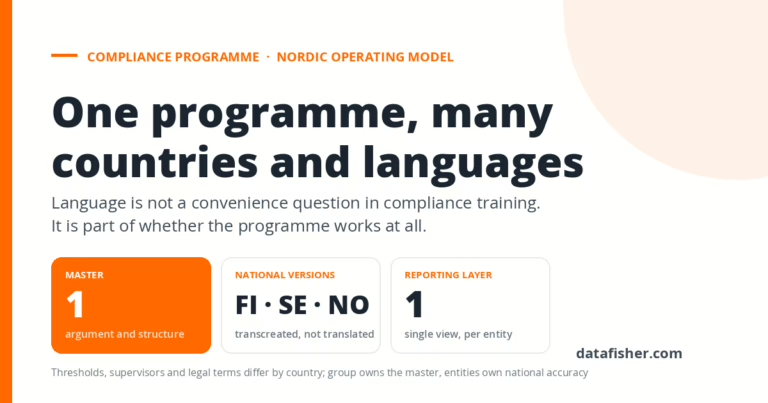 One Compliance Programme, Many Countries and Languages: A Nordic Operating Model
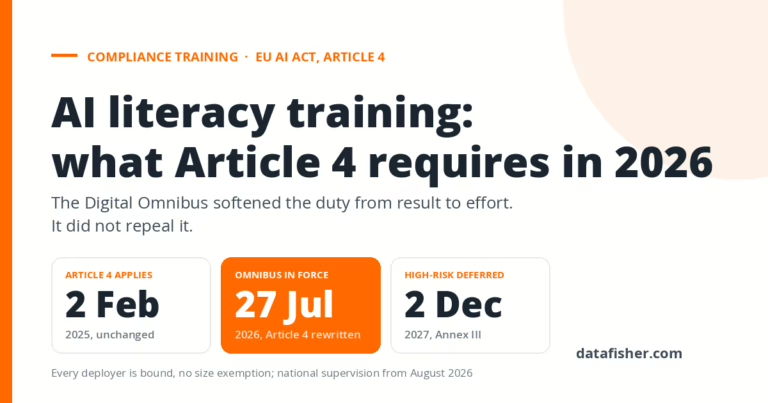 AI Literacy Training Under the EU AI Act: What Article 4 Requires in 2026
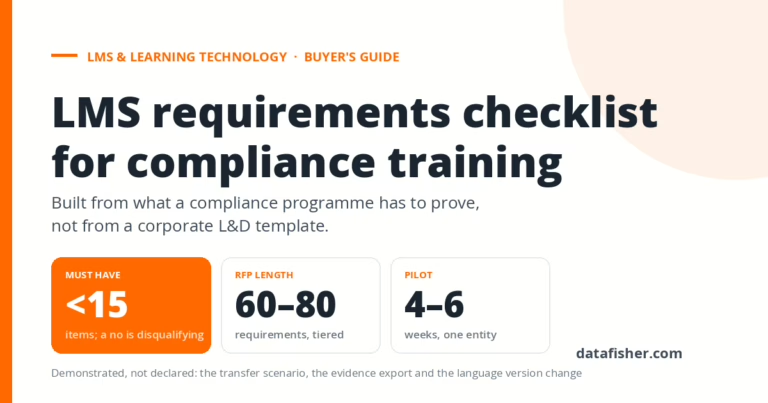 LMS requirements checklist for compliance training