
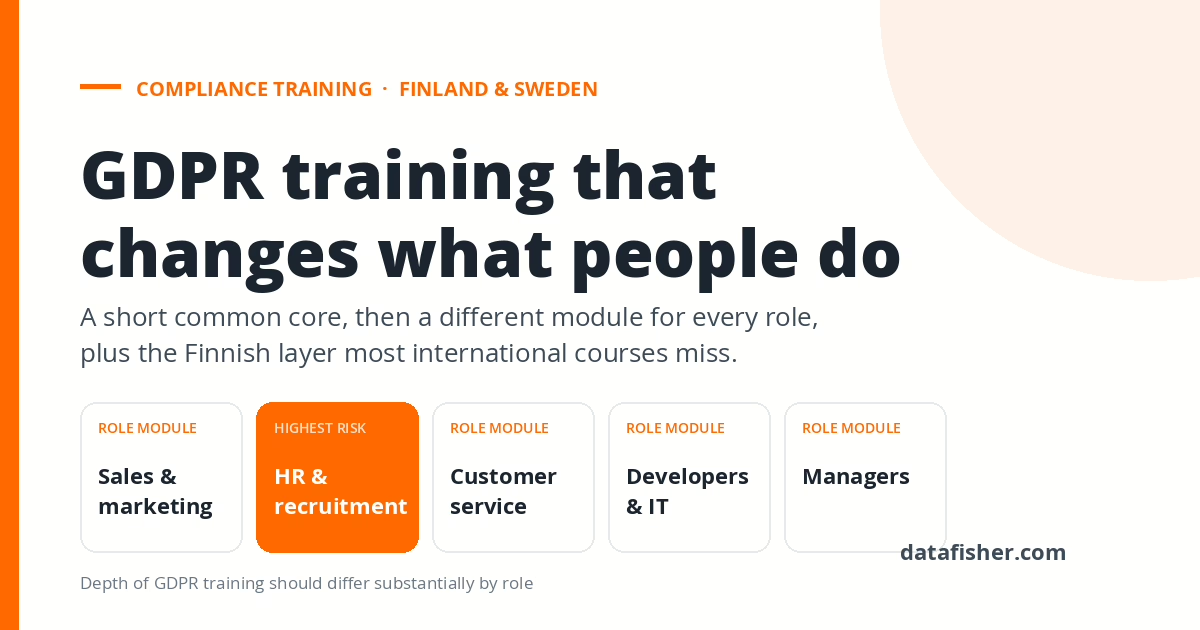
GDPR Training by Role: A Finnish and Swedish Guide
Most GDPR training is organised around the regulation. It starts with the principles in Article 5, moves through lawful bases, covers data subject rights, and ends with a quiz. Employees complete it, score well, and then, three weeks later, export a customer list to a personal spreadsheet to work on at home.
That gap is not a knowledge problem. It is a mapping problem. The employee learned the principles and never learned which of the specific things they do every day the principles apply to. Training organised around the law teaches the law. Training organised around the job changes what people do.
This guide is built the second way. It sets out what GDPR training needs to contain for each function, what Finnish and Swedish supervisory authorities actually take action on, and the layer of Finnish law that most international GDPR courses omit entirely.
The baseline everyone needs, and it is short
There is a common core, but it is far smaller than most courses assume. Four things.
First, what personal data is, taught by examples from your own business rather than by definition. Most employees underestimate the scope badly. An IP address, a photograph, a job applicant’s CV, a customer complaint, a colleague’s sick note and a delivery address are all personal data, and a surprising number of people believe that business contact details are not.
Second, the idea that every use of personal data needs a reason that was decided in advance, and that finding a new use for data you already hold is a decision, not an efficiency.
Third, that data belongs with the systems the organisation approved, and that moving it out of them is the single most common cause of incidents.
Fourth, how to recognise and escalate two specific events: a possible breach, and a request from an individual about their own data. Employees do not need to know how to handle either. They need to recognise them within hours rather than days, because both start clocks.
That is the whole baseline. Everything else should be delivered by role.
Sales and marketing
The exposure here is consent, lawful basis for direct marketing, and CRM hygiene.
Cover the practical difference between marketing to an existing customer and to a cold prospect, and the fact that Nordic national rules on electronic direct marketing sit alongside the GDPR rather than being replaced by it. Cover what happens when someone unsubscribes, which is a suppression obligation rather than a deletion obligation, and is routinely got wrong in both directions.
Cover enrichment. Buying or scraping contact data and loading it into a CRM creates an obligation to tell those people you hold their data, and the fact that a vendor sold it to you does not discharge that. This is where marketing teams create the largest quiet exposure.
Cover retention in the CRM. A prospect record that has sat untouched for six years is not evidence of a healthy pipeline.
HR and recruitment
This is the highest-risk function in most organisations and the one least likely to have received specific training.
Cover recruitment data: how long unsuccessful applicant records may be kept, what may be asked, and the rule that references and background checks have limits. Cover the handling of health information, which carries special category protection and which arrives constantly through sick notes and occupational health.
Cover employee monitoring in detail, because this is where Nordic law diverges most sharply and where a group policy imported from elsewhere is most likely to be unlawful. In Finland, the act on the protection of privacy in working life sets requirements that go beyond the GDPR, including on the processing of employee personal data, on the conditions for accessing employee email, and on drug testing and camera surveillance. Finnish employers also have co-operation obligations before introducing monitoring. Swedish employers face parallel constraints through co-determination practice and work environment rules.
Cover the departing employee, whose data must be pruned rather than archived indefinitely, and who is statistically the most likely person to submit an access request.
Customer service and support
The exposure is identity verification and oversharing.
Cover how to verify that the person on the phone is who they claim to be before discussing an account, because the most common route to an unauthorised disclosure is a helpful agent and a plausible caller. Cover what may be written in a ticket, since free-text fields accumulate opinions about customers that will later be disclosed if that customer requests their data. Cover screenshots and screen sharing in support sessions.
Cover recognising an access request even when it does not use the words. A customer who writes asking what information you hold about them has made a request, and the clock has started regardless of the channel or the wording.
Developers and IT
Cover data minimisation as a design decision rather than a principle, meaning the question of whether a field needs to exist at all.
Cover test data, which is the most common developer failure. Copying a production database into a test environment moves live personal data into a system with weaker controls and broader access, and it happens constantly.
Cover logging, where personal data accumulates invisibly. Cover deletion as a technical problem, since a system that cannot actually delete a person from every store including backups will not support the rights you have promised. Cover access control and the principle that broad standing access is itself a risk.
Cover the point at which a new feature or tool needs an assessment before it is built rather than after it ships.
Managers
Managers need a short, specific module rather than a longer version of the general one.
They need to know that they hold performance notes, absence records and sometimes health information, and that these are disclosable. They need to know that anything they write about a person may be read by that person. They need to know that they are frequently the first to hear about a possible breach and that their escalation speed determines whether the organisation meets its deadline. They need to know that they must not investigate a data protection issue themselves.
What Nordic regulators actually act on
Generic GDPR courses cite European Data Protection Board guidance and the largest EU fines. Nordic readers are supervised by Tietosuojavaltuutetun toimisto in Finland and by IMY in Sweden, and both publish decisions that are far more concrete and far more relevant than anything at EU level.
Pull two or three recent decisions from each authority’s decision register when you build your course, and use them as worked examples. Prioritise decisions that turn on employee conduct, since those are the ones training can influence: unauthorised access to records by staff, excessive retention, failures to respond to access requests within the deadline, and disclosures to the wrong recipient.
Two national features are worth knowing. The Finnish administrative fine process runs through a collegial sanctions body rather than the Data Protection Ombudsman acting alone, and Finnish law restricts the imposition of administrative fines on public authorities, which changes the enforcement picture in the Finnish public sector considerably. Sweden’s IMY has issued substantial sanction fees against both private and public bodies. Confirm the current position on both before publishing, since national supplementary legislation is periodically amended.
The Finnish layer that international courses miss
If your organisation has Finnish employees and your GDPR training was written outside Finland, it is very likely incomplete.
Finland has separate legislation on the protection of privacy in working life which regulates the processing of employee personal data more tightly than the GDPR alone. It constrains what an employer may collect about an employee, requires that data be collected primarily from the employee themselves, and sets specific conditions before an employer may access an employee’s email or introduce certain forms of monitoring. It also interacts with co-operation obligations, so that introducing monitoring is a process rather than a decision.
An international course that teaches Finnish managers only the GDPR position on monitoring will teach them something that is accurate and insufficient, and will leave them believing they may do things they may not. This is the clearest argument in this entire topic for a Finnish version of the course rather than a Finnish translation of the English one.
How often to run it
The GDPR does not set an interval. What supervisors look for is currency and coverage: that training reflects your current processing and current systems, and that everyone who needs it has had it, including people who joined last month.
A practical rhythm for most organisations is a full role-based module at onboarding, a short refresher annually for everyone, a deeper refresher for high-exposure roles, and an event-triggered update when you deploy a significant new system or when your supervisory authority publishes guidance that changes your position. Deploying AI tooling is the most common current trigger and usually requires both an assessment and a training update.
Evidencing it
Keep the role mapping that determined who received what, the content with version dates, delivery records including new joiners and contractors, and a record of the review cycle. If you decided a group needed less, record why.
A documented decision is defensible; an undocumented gap is not.
Frequently asked questions
Is GDPR training mandatory for employees?
There is no article that says train your staff in those words. The obligation arrives through Article 32, which requires appropriate organisational measures, through Article 39, which makes staff awareness training part of the DPO’s tasks where one is appointed, and through accountability under Article 5(2). In practice a supervisory authority investigating an incident will ask what training the people involved had received, and no answer is a bad answer.
How often should GDPR training be repeated?
The regulation sets no interval. Aim for onboarding, an annual refresher, deeper cycles for exposed roles, and updates triggered by significant change.
Who needs GDPR training?
Anyone who handles personal data, which in most organisations is nearly everyone. The depth should differ substantially by role.
What should GDPR training include?
A short common core covering what personal data is, why every use needs a reason, keeping data in approved systems, and recognising breaches and access requests. Everything beyond that should be role-specific.
Does the GDPR apply to employee data?
Yes, and in Finland the act on the protection of privacy in working life adds further requirements on top, particularly around monitoring and access to employee communications.
What is the fine for a GDPR breach in Finland?
The GDPR’s tiers apply, with Finnish administrative fines determined through a collegial sanctions body. Finnish law also restricts fines against public authorities. Check the ombudsman’s current decision register rather than relying on a headline figure.
Can we run one GDPR course for our whole Nordic group?
One programme, yes. One identical course, no. Finnish working life privacy requirements and national supplementary legislation mean the Finnish and Swedish versions need to differ in substance, not only in language.
Sources and further reading
- Regulation (EU) 2016/679 (GDPR) – full text on EUR-Lex
- Act on the Protection of Privacy in Working Life (759/2004) – unofficial English translation, Finlex
- Protection of privacy in working life – Finnish Ministry of Economic Affairs and Employment
- Office of the Data Protection Ombudsman (tietosuoja.fi) – Finnish supervisory authority
- Decisions of the Data Protection Ombudsman – Finlex decision register
- Sanctions board imposes three administrative fines – tietosuoja.fi, including a working-life privacy case
- Swedish Authority for Privacy Protection (IMY) – Swedish supervisory authority, news and decisions