
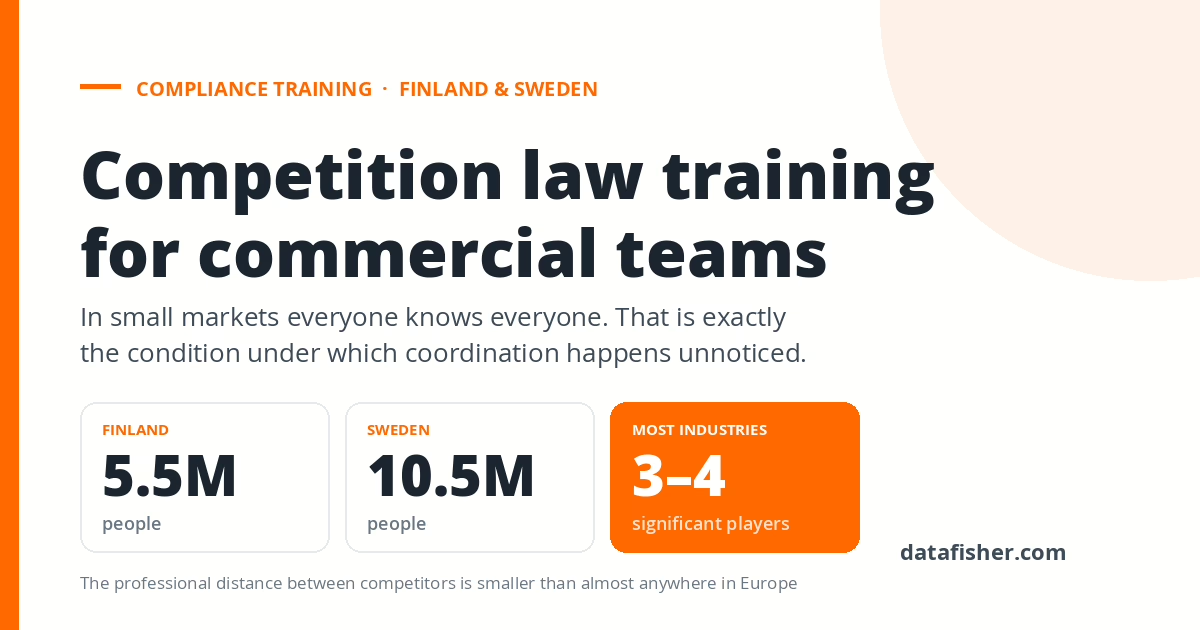
Competition Law Compliance Training for Commercial Teams
Competition law training in the Nordics has a specific problem that international courses do not address, and it is not a legal problem. It is arithmetic.
Finland has five and a half million people. Sweden has ten and a half. Most industries in either country support three or four significant players. Those players sit on the same trade association boards, employ each other’s former staff, compete for the same public tenders, meet at the same conferences, and in many sectors know each other personally. The professional and social distance between competitors is smaller here than in almost any comparable European market.
That is what makes the risk hard to see. Nobody in a Finnish or Swedish company thinks of themselves as being in a cartel. They think of themselves as being in an industry where everyone knows everyone, which is entirely true and is exactly the condition under which unlawful coordination happens without anyone deciding to do anything unlawful.
Training built on smoke-filled rooms and briefcases will not land. Training built on the trade association dinner, the former colleague now at a competitor, and the tender you both bid for will.
What is actually prohibited
Two prohibitions matter for commercial teams.
Agreements and concerted practices that restrict competition. This covers the obvious, meaning price fixing, market sharing, customer allocation and bid rigging, and the less obvious, meaning exchanges of commercially sensitive information. The critical point for training is that a concerted practice requires no agreement. Parallel behaviour arising from an exchange of information is enough, and a one-way disclosure where the recipient says nothing still exposes both parties, because the recipient cannot un-know what they were told and is presumed to take it into account.
Abuse of a dominant position. Relevant where a company holds a strong position in a defined market, which in small Nordic markets happens at market shares that would be unremarkable elsewhere. This is the reason the topic reaches companies that do not think of themselves as large.
Vertical restrictions also catch many Nordic manufacturers and distributors, particularly resale price maintenance, where a supplier tells a reseller what price to charge. This is very commonly misunderstood as normal commercial management.
Who needs training, in order of exposure
Sales and commercial management first. They meet competitors, discuss markets, and set prices.
Tendering and bid teams second. Bid rigging in construction, infrastructure and public procurement has been a recurring enforcement theme in both Finland and Sweden, and the mechanics of a public tender put competitors into structured contact in ways that create both opportunity and appearance of coordination.
Procurement third, because buyer-side coordination is an infringement in the same way seller-side coordination is, and procurement teams often do not know that.
Senior management fourth, because they attend association boards and industry forums where the highest-risk conversations occur, and because leniency decisions are theirs.
Everyone who writes anything, fifth. Which is everyone.
Document hygiene, and why written language matters more than intent
A large proportion of the evidence in competition cases is internal communication written by people who were not doing anything unlawful and who described it badly.
Teach employees that investigators read documents years later, without context, looking for a pattern. A sales manager who writes that the market has agreed to hold prices, meaning nothing more than an observation that nobody has discounted this quarter, has written a sentence that will be read as an admission. Phrases such as understanding with, gentleman’s agreement, respecting territories, and coordinating on pricing are ordinary business shorthand that become extremely expensive in a case file.
The rule to install is simple: write what you actually mean, describe your own decisions as your own, and never describe a competitor’s conduct as something arranged between you.
Chat platforms and personal messaging deserve specific attention, because employees write far more casually there and the messages are just as discoverable.
Enforcement in Finland and Sweden
The two systems reach the same place by different routes, and the difference is worth explaining because it changes how a company experiences an investigation.
In Finland, the Competition and Consumer Authority, KKV, investigates and proposes a penalty payment to the Market Court, which decides. In Sweden, Konkurrensverket has had the power to decide on competition damages fines itself, with appeal to the Patent and Market Court. Confirm the current procedural position in both countries before publishing, as enforcement powers in this area have been revised in recent years.
Both authorities operate leniency programmes. Both conduct unannounced inspections, which is a large enough topic to have its own guide.
Two consequences beyond the fine matter to individuals. Sweden provides for trading prohibitions against individuals involved in serious infringements, which removes a person’s ability to run a business. Both countries expose companies to follow-on damages claims from customers, which frequently exceed the public fine.
Neither Finland nor Sweden criminalises cartel participation in the way some jurisdictions do, which is a fact worth stating plainly because employees who have absorbed American framing sometimes believe they face imprisonment and sometimes believe, once told they do not, that the consequences are trivial. Neither is right.
Leniency and the decision that follows discovery
The single most valuable thing a compliance function can do before an incident is make sure the organisation knows how leniency works, because leniency rewards being first and the value decays by the day.
Full immunity is generally available only to the first applicant. Later applicants may receive reductions. That structure means that once one participant suspects the conduct has been discovered, the incentive to apply becomes overwhelming, and the company that spends three weeks deliberating usually finds someone else has gone first.
The practical implication is a pre-agreed internal route: who is told, who decides, and how fast. Most organisations discover they do not have one at the worst possible moment.
Trade associations and the small-market problem
Association work is legitimate, valuable and structurally the highest-risk lawful gathering in commercial life, because it assembles precisely the set of competitors, with an agenda and minutes.
Nordic economies are unusually association-dense, and Nordic associations perform genuine functions in standardisation, training, statistics and policy. That legitimacy is what makes the risk invisible.
The individual behaviours to train are narrow and rehearsable: recognise when a discussion moves to pricing, capacity, customers or future commercial intentions; object out loud; leave if it continues; and ensure your objection and departure are recorded in the minutes. The last part is what protects both you and the company, and it is the part people forget.
Benchmarking and statistics programmes run by associations deserve specific scrutiny, since they are lawful only where the data is sufficiently aggregated, historic and non-attributable, and many long-running programmes do not actually meet those conditions.
Sustainability collaboration
Joint sustainability initiatives between competitors have become common in the Nordics and are an area of active regulatory attention. The intention being good does not remove the analysis, and agreements on what products to stop selling, or on cost pass-through, are agreements between competitors regardless of purpose. Train commercial teams to route these through legal before they are discussed rather than after they are agreed.
Building the programme
Deliver a substantive module to sales, tendering, procurement and senior management, built on scenarios drawn from your sector rather than from generic case law. Deliver a short module to everyone else focused on document hygiene and on what to do if a competitor raises something.
Give the exposed teams something they can carry: a one-page guide on what can and cannot be discussed, and a script for exiting a conversation. Rehearse the association scenario, because objecting to a senior person in a room full of industry peers is socially difficult and nobody does it well the first time.
Then make sure the reporting route works. An employee who realises after a conversation that something was said needs somewhere to take that quickly, and the value of hearing about it early is very high.
Frequently asked questions
What does competition law compliance training need to cover?
The prohibitions in the language of everyday commercial behaviour, information exchange as the core risk, document hygiene, trade association conduct, and what to do when a competitor starts a conversation you should not be in.
Is it illegal to talk to a competitor?
No. Contact with competitors is normal and lawful. Exchanging commercially sensitive information about pricing, capacity, customers or future intentions is not, and a one-way disclosure exposes both parties.
Who in a company needs competition law training?
Sales and commercial management, tendering teams, procurement, and senior management first. A shorter module on documents and escalation for everyone else.
What is bid rigging?
Coordination between bidders on a tender, including cover bidding, bid rotation and market sharing. It has been a recurring enforcement theme in both Finnish and Swedish construction and public procurement.
Can individuals be personally liable for competition infringements?
Sweden provides for trading prohibitions against individuals involved in serious infringements. Neither country criminalises cartel conduct in the way some jurisdictions do, but personal and reputational consequences are real.
What is a leniency programme?
A route by which a participant that reports conduct can obtain immunity or a reduced penalty. Full immunity is generally available only to the first applicant, which is why internal decision speed matters so much.
Are joint sustainability initiatives between competitors allowed?
They require the same analysis as any other collaboration between competitors. Good intentions do not remove the assessment, and the analysis should happen before the discussion rather than after.
Sources and further reading
- Finnish Competition Act (948/2011) – unofficial English translation, Finlex
- Cartels and other horizontal restrictions on competition – Finnish Competition and Consumer Authority (KKV)
- Reveal a cartel and get immunity from the penalty payment – KKV leniency guidance
- FCCA proposes EUR 9.4 million in penalty payments for a wild-berry purchasing cartel – KKV press release, May 2026, a buyer-side coordination case
- How to apply for leniency – Swedish Competition Authority (Konkurrensverket), including trading-prohibition immunity
- Leniency – European Commission, Competition Policy